Month: August 2013

CALAVERAS

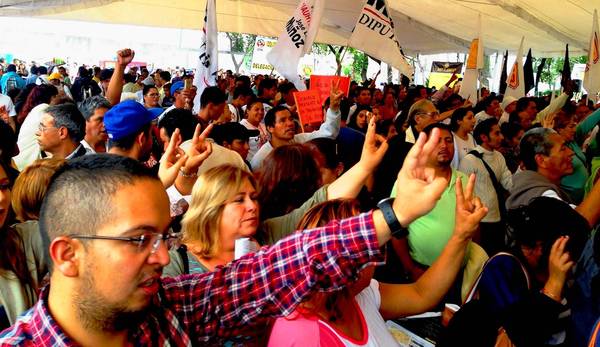
I stumbled across these dancing calaveras this morning while jogging on the Paseo de la Reforma, in Mexico City. Turns out the group was celebrating the legacy of the great Mexican satirist and folk artist Jose Guadalupe Posada.

Mexico City and Aguascalientes, Posada’s hometown, have gone all out this year, the centenary of Posada’s death, to recognize the work of a man who died in obscurity, but whose genius was recognized–and whose reputation was revived–by Diego Rivera, among others, a few decades after Posada’s death.

Today Posada imagery is everywhere in Mexico, and I’m sure that for some, its ubiquity has diminished its power. But not I. Even when I find it leering at me next to a Frida Kahlo refrigerator magnet, the smiling, dandified face of death still manages to deliver a shiver and a shock.

FREE

Mexico's justice system


Originally posted at www.latimes.com:

Two cases bolster suspicion of Mexico’s justice system

The collapse of high-profile cases against two well-connected men leaves many dismayed by what they see as enduring dysfunction.

By Richard Fausset and Tracy Wilkinson
August 9, 2013, 6:42 p.m.

MEXICO CITY — They were two of Mexico’s most flamboyant bad boys, symbols for many here of all that was wrong with this country in the 1980s and ’90s.

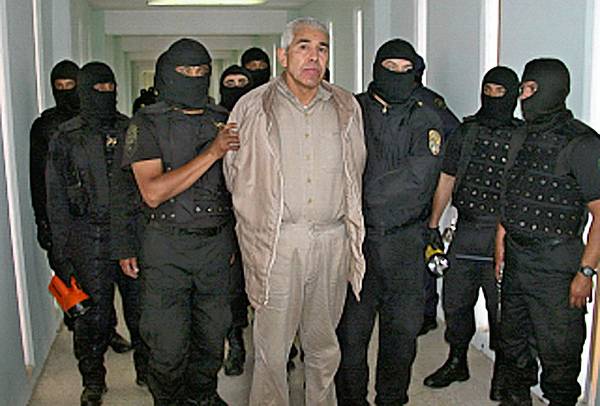
Rafael Caro Quintero was a high-rolling drug lord sent to prison for the 1985 kidnapping, torture and slaying of an agent with the U.S. Drug Enforcement Administration.

Raul Salinas, the brother of a former Mexican president, was a free-spending playboy. He was convicted, and then acquitted, of the 1994 killing of a top politician. He was also suspected of stealing millions of dollars from the government.

But in recent days, the old criminal cases against these two characters have fallen apart, leaving many dismayed by what they perceive as the enduring dysfunction of the Mexican justice system.

Even though Mexican officials, with U.S. advisors and millions of dollars of U.S. aid, have focused in recent years on reforming the system, these two cases are likely to bolster the suspicion that the law still does not apply to the well-connected and the powerful — either because of their enduring influence, or the incompetence of those who pursue them.

Historian and academic Lorenzo Meyer in a magazine interview this week said the Salinas ruling last month was, in effect, a message to the Mexican people:

“Listen, you drooling pack of idiots, the true political situation is this … at the end of the day, we, the political class, understand the nature of corruption in this country, and it’s not going to change.”

Though spectacular meltdowns of major criminal cases are common in Mexico, these were standouts, with each suspect, in his way, shaping the course of history.

Salinas’ Champagne lifestyle — his numerous luxury properties, and millions stashed in overseas bank accounts — may have contributed to the public’s rejection of the Institutional Revolutionary Party, or PRI, the once all-powerful institution that counted the Salinas family as influential members.

Caro Quintero was a legendary drug lord. A Times article from 1992 mentions how a witness in a criminal trial described him at a lavish party smoking cocaine on the back of a prancing horse.

On Friday, Caro Quintero, a founder of the Guadalajara drug cartel, was freed on a technicality after 28 years behind bars. A panel of judges declared that the slain DEA agent, Enrique “Kiki” Camarena, could not be considered a member of the diplomatic corps; as a result, the judges ruled, the case should not have been tried in federal court.

In Washington, the DEA said it was “deeply troubled” by Caro Quintero’s release and indicated the U.S. government would attempt to have him extradited to face charges in the United States.

“Caro Quintero was the mastermind and organizer of this atrocious act,” the DEA said in a statement, referring to the torture and slaying of Camarena. “We are reminded every day of the ultimate sacrifice paid by Special Agent Camarena.”

Although other drug kingpins and cartels have eclipsed the 61-year-old Caro Quintero, U.S. officials believe he has continued to run trafficking and money-laundering operations from prison. In June, the Treasury Department added several of his alleged associates to its so-called kingpin list, imposing sanctions on 18 people and 15 companies.

The Treasury Department alleged that Caro Quintero’s money was bankrolling, among other things, real estate projects, a luxury spa, a shoe store and a swimming pool company.

The cases against Caro Quintero and Salinas collapsed less than a year into the government of President Enrique Peña Nieto, whose victory last year marked the return of the PRI after a 12-year absence.

The party ran the country as a quasi-dictatorship for much of the 20th century, a time when the courts were often used as a tool for the party’s political agenda. Peña Nieto promises that the party has become more transparent and democratic. But he will have to work particularly hard to prove it, given the sins of his party’s past old-school leaders, known as the “dinosaurs.”

Further complicating the situation is the fact that Peña Nieto is part of a political clique closely linked to the powerful Salinas family. Peña Nieto’s attorney general plans to appeal the ruling in the Salinas case. But that hasn’t stopped some from speculating that the fix is in.

“Damn if we aren’t returning to the times of Jurassic Park,” Twitter user Robert Cabrera Vera wrote Friday. “…a few days ago, Raul Salinas and now Caro Quintero.”

Salinas, whose brother Carlos Salinas was president of Mexico from 1988 to 1994, was exonerated last month of the charge of “illicit enrichment” by federal judge Carlos Lopez Cruz. Known as el hermano incomodo, “the inconvenient brother,” Raul Salinas dominated Mexican headlines for years for living like Mexican pasha, even though he was employed as a government bureaucrat.

He was also found guilty of the 1994 slaying of Jose Francisco Ruiz Massieu, a PRI leader. Salinas spent 10 years in prison for the crime, but was acquitted and freed in 2005.

In acquitting Salinas of the illicit enrichment charge, the judge acknowledged that his assets certainly “grew substantially” for a government worker. But Cruz said prosecutors were unable to prove that the wealth was the result of “an improper public function.”

David Shirk, who heads the Justice in Mexico Project at the University of San Diego, said Mexican prosecutors have a long history of sloppy work, because for years they didn’t have to do much to convince judges that the accused deserved to be found guilty.

“It’s like the Three Little Pigs,” Shirk said. “Mexican prosecutors were building straw houses — and they need to start building them out of brick.”

The U.S.-backed judicial reform program, which has not been fully implemented, will in theory force courts to follow evidentiary and procedural rules more closely, giving defense attorneys more opportunities to poke holes in flawed cases.

In a radio interview Friday, Caro Quintero’s former attorney, Jose Luis Guizar, said his client benefited from the bungling of federal prosecutors.

“The problem is that the prosecutors get to those places for reasons of cronyism, political friendships, and have everything but ability,” Guizar said.

The slaying of agent Camarena severely strained relations between Mexico and Washington in the mid-1980s. U.S. officials were furious at Mexican authorities, suspicious that there had been high-level cooperation with Caro Quintero and, at minimum, a cover-up by what was supposedly a friendly government.

It was years before Mexican law enforcement could regain any trust from the DEA and other U.S. counterparts, and the relationship is still regularly tested. DEA agents for years carried the memory of Camarena as a symbol of sacrifice and heroism in the face of dangers enhanced by official corruption.

“The decision [by traffickers] to kill a U.S. federal agent changed everything,” James Kuykendall, a retired DEA agent who was Camarena’s boss in Guadalajara, said in a telephone interview Friday from his home in Laredo, Texas.

Salinas has always maintained his innocence, saying that he took advantage of legal business opportunities presented to him as the brother of a president. The judge ruled that the government would have to return Salinas’ seized property if the attorney general loses the appeal. Mexican media reported that those assets include more than $17 million and 41 properties scattered throughout Mexico.

Cecilia Sanchez of The Times’ Mexico City bureau contributed to this report.

Copyright © 2013, Los Angeles Times

Photo: Rafael Caro Quintero, seen in prison in 2005, was released on a technicality Friday after being convicted of the 1985 kidnapping and slaying of Enrique “Kiki” Camarena, a U.S. Drug Enforcement Administration agent. (January 27, 2005, via LA Times)

HISTORIA DE LA MUSICA ROCK

Browsing MetaFilter this week, I stumbled on this episode of the public radio show Sound Opinions, in which journalists Josh Norek and Alejandro Franco offer a brief, English-language history of Mexican rock and roll.

Their tour brings us up to about the late 1990s, when Monterrey was at peace, and its middle-class kids were responsible for a varied and fascinating explosion of rock en español .

Where is Mexican music headed these days? Our hosts point to DJ outfits like Nortec Collective and the Mexican Institute of Sound, which mix traditional, regional styles with modern dance music. But under the stultifying gloss of Mexican pop-rock, there are other strange new hybrids hatching.

The show:

YouTube clip: Monterrey’s El Gran Silencio plays their “Cumbia Lunera,” from the classic 2000 CD Chuntaros Radio Poder.

REGARDING PEMEX

Pemex rally in Mexico


Originally posted at www.latimes.com:

Mexico’s president on dangerous ground as he pushes Pemex reform

Mexican President Enrique Peña Nieto wants to open the Pemex oil monopoly to private and foreign investment. To many Mexicans, that’s blasphemy.

By Tracy Wilkinson and Richard Fausset
August 5, 2013, 6:00 a.m.

MEXICO CITY — If Mexico had a crown jewel, it would be the giant state oil monopoly Petroleos Mexicanos, or Pemex. Year after year, it has poured billions of dollars into the state treasury, historically paying for schools, hospitals, dams, highways, ports and more.

The seizure of foreign oil companies 75 years ago that created the company is a cause for annual celebrations affirming Mexico’s fierce sense of independence from outside interference.

Yet even as the country’s new president, Enrique Peña Nieto, credits Pemex with building the nation, his administration acknowledges that the notoriously inefficient conglomerate is in trouble: If it is not opened to private and foreign investment, Mexico, the world’s ninth-largest oil producer, will become a net energy importer by 2020, officials say.

As Peña Nieto moves ahead with a plan to overhaul Pemex, he is navigating the most perilous political minefield of his young presidency. He is toying with taboos and challenging revered perceptions surrounding the nation’s top revenue earner. And he is meeting with impassioned opposition.

At the back of a recent rally for Pemex, Jesus Castillo Sanchez, a 46-year-old handyman, waved a giant Mexican flag as if he’d just taken a hill in battle. Booting the foreign oil companies in 1938 “gave Mexico its true independence from the great powers,” Castillo said. “After [the foreigners] bring their oil platforms, they will bring their armies and their troops.”

The president is expected to introduce landmark energy reform legislation, including proposals addressing Pemex, as early as this week.

The government and industry experts contend that Mexico needs advanced technical expertise from outside companies to find and retrieve oil and gas from deep water and shale-rock formations that are believed to hold more than half the country’s estimated 14 billion barrels of reserves.

But “Pemex is not allowed … to choose associations … to reduce the level of risk that you run” in deep-water exploration, Carlos Morales Gil, Pemex director of exploration and production, said in an interview. “What Pemex needs is budget autonomy and flexibility” to form joint ventures, he said.

Making that possible could require changing the constitution, and that could prove a bruising battle for Peña Nieto. The matter is so sensitive, so wrapped up in Mexico’s ability to assert its independence from foreign meddling, that when Peña Nieto, speaking in London, suggested that the other major political parties had already agreed to reform, several politicians back in Mexico went ballistic.

Yet the problems plaguing Pemex are legendary. With corruption, poor management, a union that demands enormous benefits and a corporate structure that fosters duplicate jobs, Pemex is a model of how not to run an oil company.

According to a 2011 study by the Texas-based Baker Institute, Pemex, with about 140,000 employees, produced revenue of $585,000 per employee, a quarter of the per-employee revenue of British oil giant BP and about half that of the partially state-owned Brazilian oil company Petrobras.

Morales, the Pemex executive, acknowledged that Mexico was 30 years behind the industry standard in deep-water exploration. Pemex, he said, hadn’t felt pressure to pursue the riskier search because it had so much readily accessible shallow-water and inland oil. Consequently, Mexican engineers did not keep up with the widening technological know-how that has benefited competitors.

A case in point is the Cantarell oil field, in the Bay of Campeche. It was discovered in 1976 by a fisherman who noticed his nets were being ruined by oil. Pemex engineers soon realized he had stumbled on one of the largest oil fields in the world.

But in the mid-2000s, production at Cantarell peaked, and it has declined rapidly, while a second big find, Ku-Maloob-Zaap, has already been bled of two-thirds of its reserves.

In all, Pemex’s production of crude has declined steadily to 2.6 million barrels a day — from a high in 2004 of 3.5 million — stabilizing only in the last year or so.

There’s plenty more out there, but experts say Mexico can’t get to it without outside help.

“Mexico, outside of the U.S., probably has the widest array of energy plays that anybody has in the world: shallow water, deep water, shale gas, shale oil, tremendous marginal fields that have largely been neglected over the last 40 years,” said John Padilla, managing director of the international energy consulting firm IPD Latin America. “It’s too much for any one company to handle. There’s nobody in the world that could do that.”

The Mexican Constitution says that raw materials found in the land, like oil and gas, belong to the state, requiring a constitutional amendment for future agreements that might touch on ownership of resources.

Private operators could pay a tax, based on percentage of revenue or profit, for the right to pump. Or they could enter into joint-venture agreements with Pemex, each side sharing risks and benefits.

But how outside investors share revenue, and Mexico’s long-standing refusal to cede any ownership of the oil itself, remain a key obstacle.

The problem is that companies probably would prefer to take a cut of the oil itself; the amount of “booked reserves” to which a company has the legal rights is used by analysts to set the company’s stock price.

U.S. companies could be major beneficiaries, because they can take advantage of their geographical proximity. But big multinationals are most likely to sign up first because they are in the best position to assume what will still be high costs and risks.

For Peña Nieto and his Institutional Revolutionary Party, or PRI, the challenge is to reverse an allegiance to the very myths of nationalism and identity that built and sustained the party for seven decades of nearly unchallenged rule.

Energy reform was a centerpiece of Peña Nieto’s presidential campaign platform last year. He now appears confident he can muster unity within his party to support his initiative and expect backing from the conservative National Action Party, or PAN. Between the two parties, they could overcome legislative opposition from the leftist Democratic Revolution Party, or PRD, although the PAN is in the throes of bitter, divisive infighting.

As compelling as the argument is for reform, the opposition is just as vehement.

“No, no, definitely no,” said Jesus Zambrano, head of the PRD. Peña Nieto, he said, seems willing “to sell the golden eggs and the goose that laid them!”

Cuauhtemoc Cardenas, a founder of the PRD, is the son of none other than Lazaro Cardenas, the Mexican president widely regarded as a hero for nationalizing the oil industry. The younger Cardenas has announced his opposition to the “privatization” of Pemex.

“They must tell us why they want to privatize,” Cardenas, a former presidential candidate, said. “They must give us figures; tell us where the money is lacking; why; why they can’t get loans.” The constitution, he said, must not be rewritten.

He and others said Pemex’s performance can be improved by reducing its stiff tax burden — it pays 70% of its revenue to the government, which limits its ability to finance expansion, upkeep or exploration — and by reining in its hugely corrupt union. The union has saddled Pemex with $100 billion in pension liabilities while showering longtime union President Carlos Romero Deschamps and his family with private jets and designer clothing.

In a poll released in June, 65% of Mexicans said they opposed opening Pemex to additional private investment. The survey, conducted last fall by the Center for Economic Research and Teaching, said the oil sector remained one of the nation’s most enduring repositories of Mexican nationalism.

At the foot of a giant statue of Lazaro Cardenas, hundreds of PRD supporters rallied in June to protect Pemex from the intrusion of external investors. Among them was Castillo, the handyman, who said that the fate of Pemex, in his view, was tied inevitably to a past of Spanish colonialism and aU.S. military invasion that subjected Mexicans to years of economic domination.

Peña Nieto and senior PRI officials insist they are not planning to privatize Pemex but to modernize it and make it more efficient. The government has deliberately withheld submitting its detailed proposal to the legislature until after the summer break, local elections and the passing of other, less fraught reform initiatives.

U.S. and other foreign energy firms worry that Peña Nieto’s reform won’t go far enough. They have watched as attempts to open up the company, widely regarded as one of the most closed and antiquated in the world, fell apart.

“Mexico has a very small window of opportunity,” said an executive with Exxon Mobil, who requested anonymity because of the sensitive nature of the debate. “The risk is they approve a watered-down reform, and investors are skeptical about that. You can’t just keep kicking the can down the road.”

wilkinson@latimes.com

richard.fausset@latimes.com
Copyright © 2013, Los Angeles Times

Photo: Emmanuel Martinez, foreground, left, a 25-year-old government worker, sings the Mexican national anthem along with a crowd of hundreds to close a rally against opening the national oil company, Pemex, to foreign investment. “Oil is a treasure that belongs to the Mexican people,” Martinez said.(Richard Fausset / Los Angeles Times / June 26, 2013)


THE OTHER BORDER

la-fg-mexico-other-border


Originally posted at www.latimes.com:

Anarchy along Mexico’s southern border crossings

Unmonitored goods and migrants cross the Suchiate River all day long in southern Mexico, where criminals and corrupt officials lie in wait.

By Richard Fausset
August 3, 2013, 10:00 a.m.

CIUDAD HIDALGO, Mexico — The Mexican government is pledging to bring order to its wild southern border. The stakes couldn’t be higher, and the job couldn’t be more difficult.

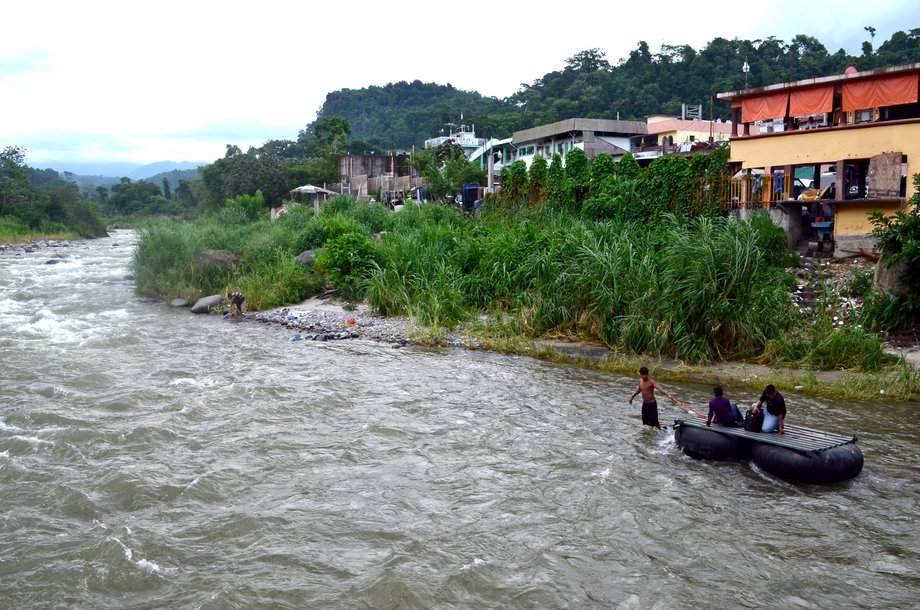
The proof lies in this dusty border town of 14,000 people. Here, unmonitored goods and travelers float across the wide Suchiate River — the boundary between Guatemala and the Mexican state of Chiapas — on a flotilla of inner-tube rafts. They cross all day long, in plain sight of Mexican authorities stationed a few yards upriver at an official border crossing.

Some of the Central Americans are visiting just for the day. Others are hoping to find work on Mexican coffee plantations or banana farms. But many will continue north toward the United States.

Photos: Anarchy along Mexico’s southern border crossings

There is no guarantee they will ever get there. Lying in wait are Mexican criminals, and even Mexican officials, who aim to kidnap northbound travelers, extort money from them and sometimes even rape and kill them. About 10,000 such migrants have disappeared in Mexico every year since 2008, according to Mexican government estimates.

Luis Martinez, a 33-year-old migrant from Honduras, had crossed the Suchiate without incident early one morning in June. He knew he was risking his life by moving on. But he said that the crippled Honduran economy left him little choice. He needed to work. He needed to earn.

“It’s going to be hard,” he said. “We’ve heard about it all: the cartels, the kidnappings, the robberies, everything.”

Along with drug violence and the slaying of journalists, the ugly fate of the Central American migrant has become one of the darkest stains on Mexico’s reputation.

In recent weeks, however, the government of President Enrique Peña Nieto has pledged to bring new order to the border region. Interior Minister Miguel Angel Osorio Chong said the new plans will “ensure that [migrants] don’t suffer.”

Security at border crossings will be strengthened, officials say, and sophisticated “internal control” stations will be set up a few miles inside the country along commonly-used migration routes, to better monitor the movement of goods and people.

The government is also expanding a program to record the fingerprints, photos and other identifying features of migrants, the newspaper Milenio reported. High-tech biometric kiosks, partially paid for by the U.S. government, will record the data of those applying for temporary visitor and work permits.

Meanwhile, the Mexican navy, which is charged with protecting the border, has deepened its partnership with the Guatemalan military, staging coordinated operations in an effort to run off the drug cartels that have taken advantage of the border’s numerous unpoliced crossing points, Vice Adm. Francisco Ramon Tiburcio Camacho said.

The outlines of the plan raise many questions. The biometric kiosks, for example, may help authorities keep track of migrants who have been caught by authorities, or who willingly apply for legal entry. (Among other things, the data can help identify their bodies if they are found in unmarked graves). But how will they help keep tabs on the many migrants who are evading Mexican authorities?

More generally, it is unclear whether the new plans will really allow Mexico to get a handle on a border that is more than 700 miles long, and which experts say is essentially untamable. Border fences and walls, they say, would be almost impossible to build through the deep jungle and stark mountainous terrain traversed by the line separating Mexico from Guatemala and Belize.

The Mexicans reject the idea of building walls anyway, having long maintained that the U.S. southern border strategy, with its imposing barriers and armed agents, amounts to conduct unbecoming a neighbor. In a speech June 3 near the border, Osorio Chong promised that no walls would be built under the new plan. It would be focused on human rights, he said, and more in keeping with “what Mexico demands north of its border.”

Apprehensions

Immigrants detained while attemping to cross southern U.S border:

Source: U.S. Border Patrol. Graphics reporting by Tom Reinken

Khang Nguyen

The U.S. has as much interest as does Mexico in ensuring that the flow is stanched, particularly as Congress, in its consideration of immigration reform proposals, debates whether undocumented migrants can be effectively dissuaded from showing up on the U.S. doorstep.

Central American migrants are a growing source of concern for the U.S. Although the number of Mexicans detained for illegally crossing the U.S.-Mexico border has been steadily declining, the number of non-Mexicans apprehended jumped from about 47,000 in fiscal 2011 to 94,500 in fiscal 2012, according to government statistics. Most were Central Americans, fleeing the region’s stagnant economies, gang violence and street crime. (Despite their declining numbers, Mexicans, still represent the majority of people apprehended at the US border.)

The Mexican government estimates that 300,000 of those who cross the nation’s southern border each year without authorization are headed to the United States.

Recently, 27-year-old Jose Roberto Argueta Lazo of El Salvador was waiting in front of the migrant shelter in the city of Tapachula, about 20 miles north of Ciudad Hidalgo. He and his 20-year-old wife, who had crossed into Mexico on the inner-tube rafts, were plotting their trip to the U.S. They had paid a man $200 to ensure their safe passage to at least this point.

It was not much of a promise. Mexican officials already run checkpoints on major roads leading away from the frontier, rather than stopping migrants at the border. Argueta said that it was on one of these roads, between the river crossing and Tapachula, that he was threatened by a Mexican policeman who demanded $150 in cash for the right to move on.

Argueta said he would probably hire a coyote to guide him and his wife to the U.S. border. But Martinez, the Honduran migrant, said he couldn’t afford that luxury, and was instead planning to head north to the city of Arriaga to hop on “the beast,” a freight train on which immigrants are regularly preyed upon by criminal gangs.

Raul Benitez, a security expert at Mexico’s National Autonomous University, said that if his government truly wanted to address the plight of the migrants, it would look beyond the border and focus on weeding out the culture that allows so many Mexican officials on the route north to extract bribes.


Irmgard Pundt, the coordinator at the Tapachula shelter, looks beyond the border too, arguing that the government should find a way to prevent migrants from riding “the beast.”

There also is room for improvement at the official border crossings. When a Times reporter crossed from Guatemala to Mexico at Ciudad Hidalgo recently, officials did not check his identification, although they did appear to be checking the IDs of a line of Guatemalans waiting to cross on bicycles.

At another official border crossing, in the community of Talisman, Mexican officials were more dutiful in checking a U.S. traveler’s documents. Directly under the bridge over the Suchiate, however, groups of Guatemalans on rafts floated to the Mexican side, then scrambled up the riverbank through the weeds.

And throughout the day, strong-backed porters walked and waded across the shallow river, moving big sacks of fruits, vegetables and other goods, avoiding customs restrictions and cross-border taxes.

Some experts worry that if the government cracks down at well-known crossings, migrants will choose to cross the border in more remote, and perhaps more dangerous, areas.

Half an north of Ciudad Hidalgo, near a town called Tuxtla Chico, a group of young men on horseback splashed across a pristine stretch of the Suchiate and onto a bank on the Mexican side that was part of a small private ranch. The ranch owner oversaw them as they loaded up bags of corn and fertilizer to carry back to Guatemala.

A pair of young porters named Cristian and Jose Luis said that this crossing was mostly used for goods, not people.

But if authorities put the heat on the rafts down at Ciudad Hidalgo, Cristian said, he expects migrants to come splashing across here too.

richard.fausset@latimes.com

Cecilia Sanchez of The Times’ Mexico City bureau contributed to this report.

Photo: A boatman hauls an inner-tube raft and two men on the Suchiate River near Talisman, Mexico. The riverbank with the buildings is the Guatemalan side; the official border crossing is on a bridge just a few yards away. (Richard Fausset / LA Times.)