mexico

GIRLS

girls


Photo: Mannequins, Mexico City market stall. [RF]

AT THE SALON ESPAÑA

DSC_0342

DSC_0348 DSC_0359 DSC_0351
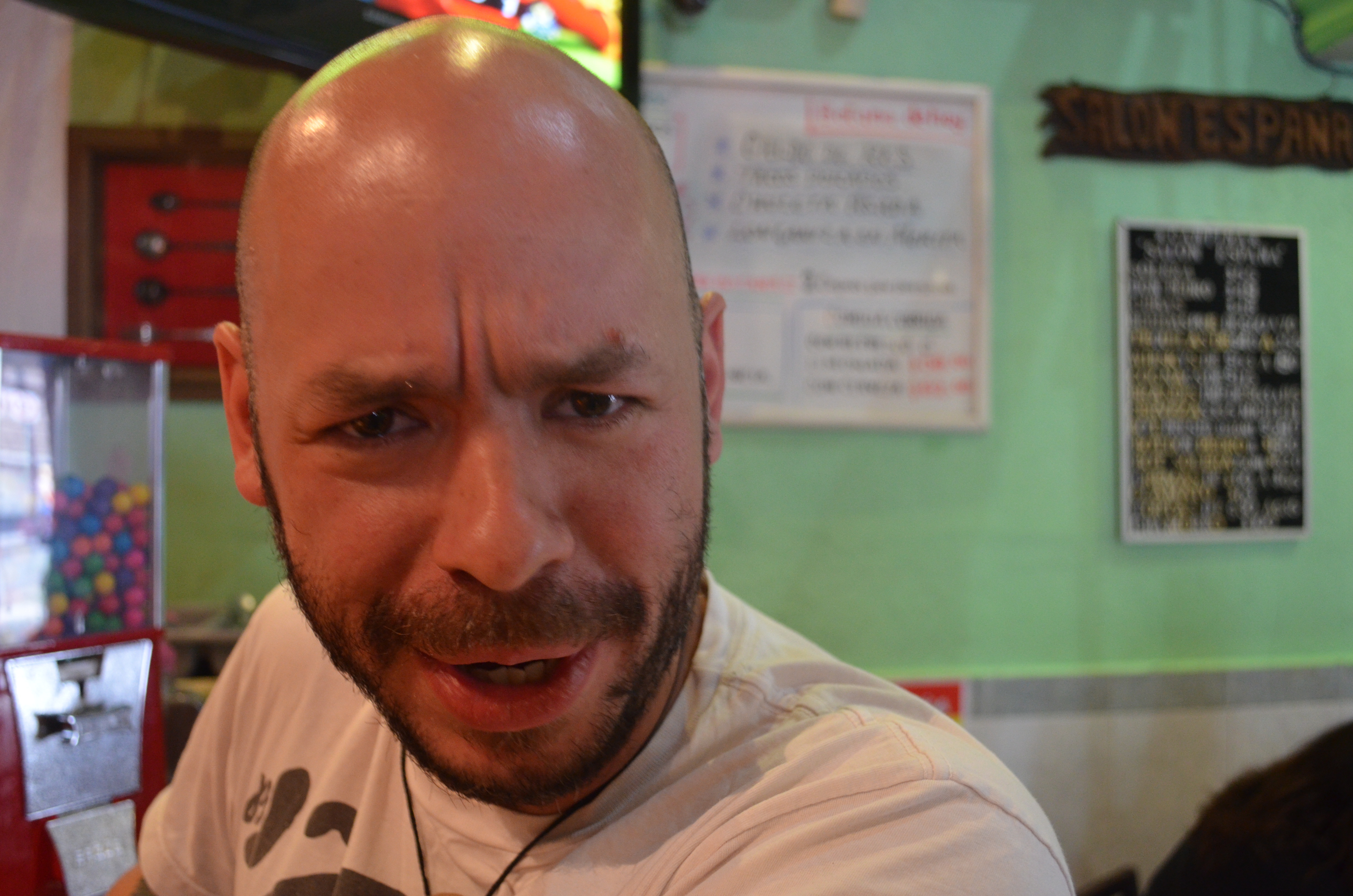
I met the painter Esteban Patiño by accident. He was loitering outside of the
Salon España, an ancient cantina in the Centro. It was Saturday afternoon, and
it felt like at least half of Mexico City’s 20 million people were sharing the
block with us, shopping and haggling and jostling, moving in and
around us, anonymous and blurred in the day-to-day koyaanisquatsi that is the
way of things here.

“You look lost,” he said.

“I’m just looking at the menu.”

We were speaking English. He told me he was from Medellin, but lived in
Atlanta — Grant Park, in fact, about eight blocks from my old house. Soon we were
inside, drinking beer, then tequila, then beer. He was visiting for a couple a
weeks, he said, and planning to hang out with his girlfriend, who was coming in
town soon from Chicago.

He had already run up a 500-peso bar tab, and he seemed to know everybody in the place. He introduced me to a few of his new Mexican friends. They shrugged their acknowledgement.

There was a soccer game going on a little television over his shoulder. Patiño
said he was bored with Atlanta. Lacked energy. He told me that he couldn’t stand Frida
Kahlo: “So you painted your spine to show you are in pain. Please.”

He said he liked it here — both Mexico City, and the cantina. He said he had been a bartender before, but he preferred this side. “The happy side,” he called it.

I told him he would be wise to watch himself in this town after dark. He shot
me a look that served to remind me that he was from Medellin. I didn’t
bring it up again.

He talked about John Henderson, the 27-year-old bartender in our Atlanta
neighborhood who was shot to death one late night in January 2009 by some kids in a gang called 30 Deep. We touched on the trouble in Mexico, but Patiño, if I remember right,
returned to the story of John Henderson and the idiots who killed him, and
settled into the thesis of how some idiots are just going to act like idiots.

He showed me the alphabet he had invented. He had had it tattooed on his forearm. He told me it appears in many of his paintings. He told me he was obsessed with the problem of language.

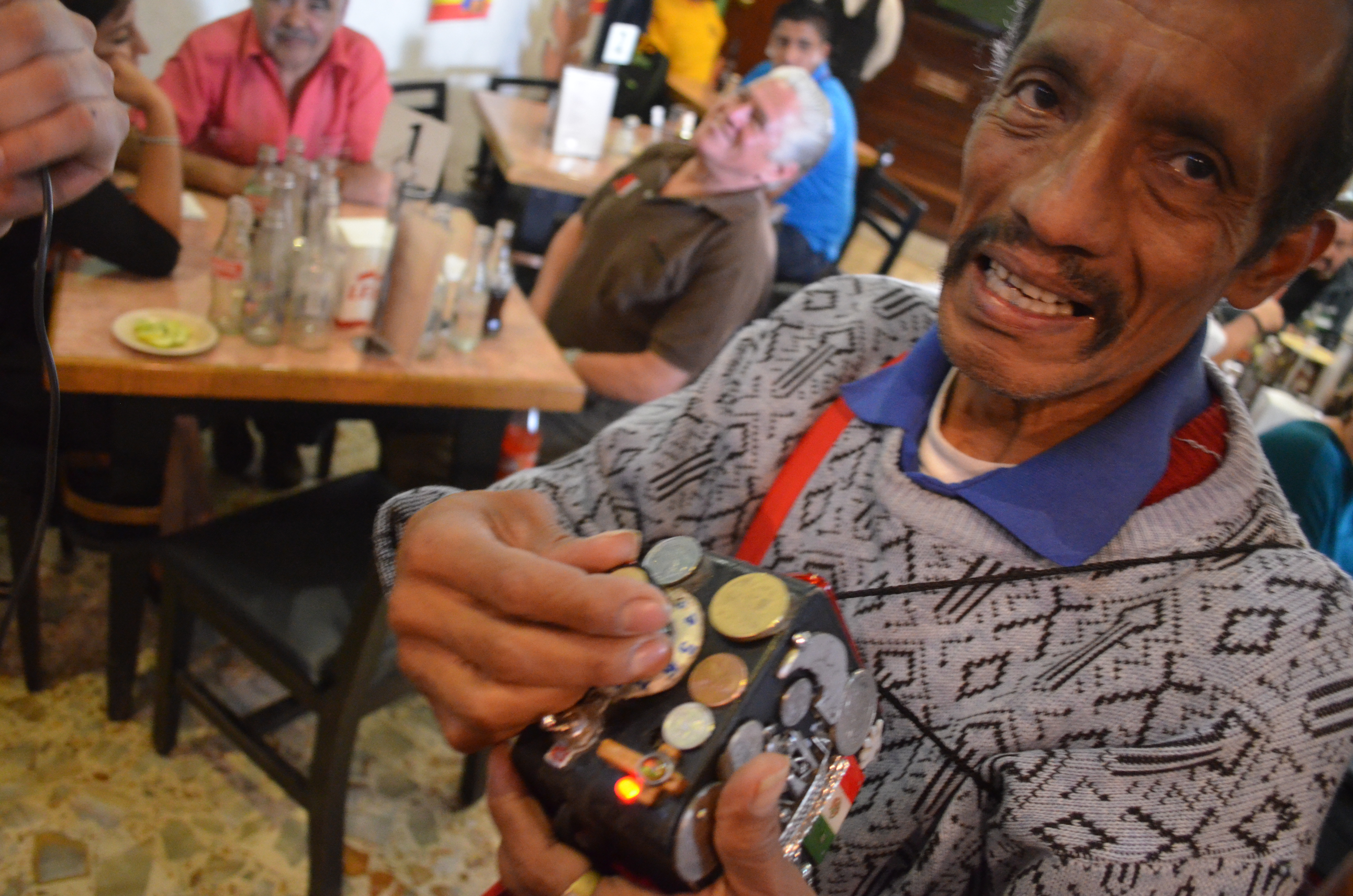
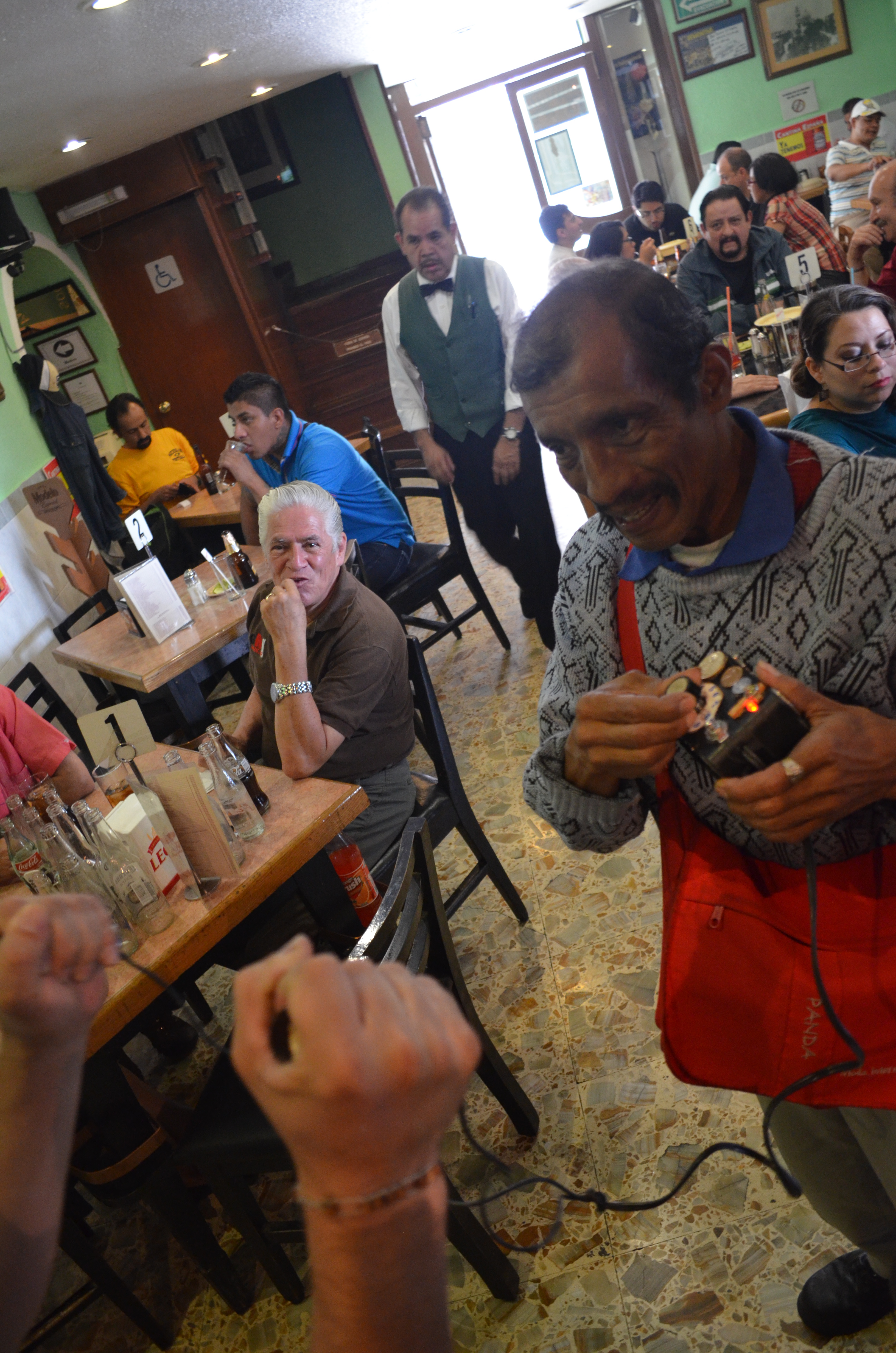
Then the old guy with the electric shock box walked in, and Patiño agreed to be
shocked a few times. The old guy would crank up his box, Patiño would drop the
crackling handles, wincing and hooting, and the old guy would smile dimly. He
charged Patiño 120 pesos for it.

You’ve got to try this, Patiño said. You really have to try it.

Photos: [RF]

FINSTERESQUE

DSC_0213

Photo: A tailor’s shop, & echoes of a certain Georgia folk artist, Ixtapalapa, Mexico, D.F., May 2013. [RF]

TOTAL TRASH

DSC_0286 DSC_0256 DSC_0312


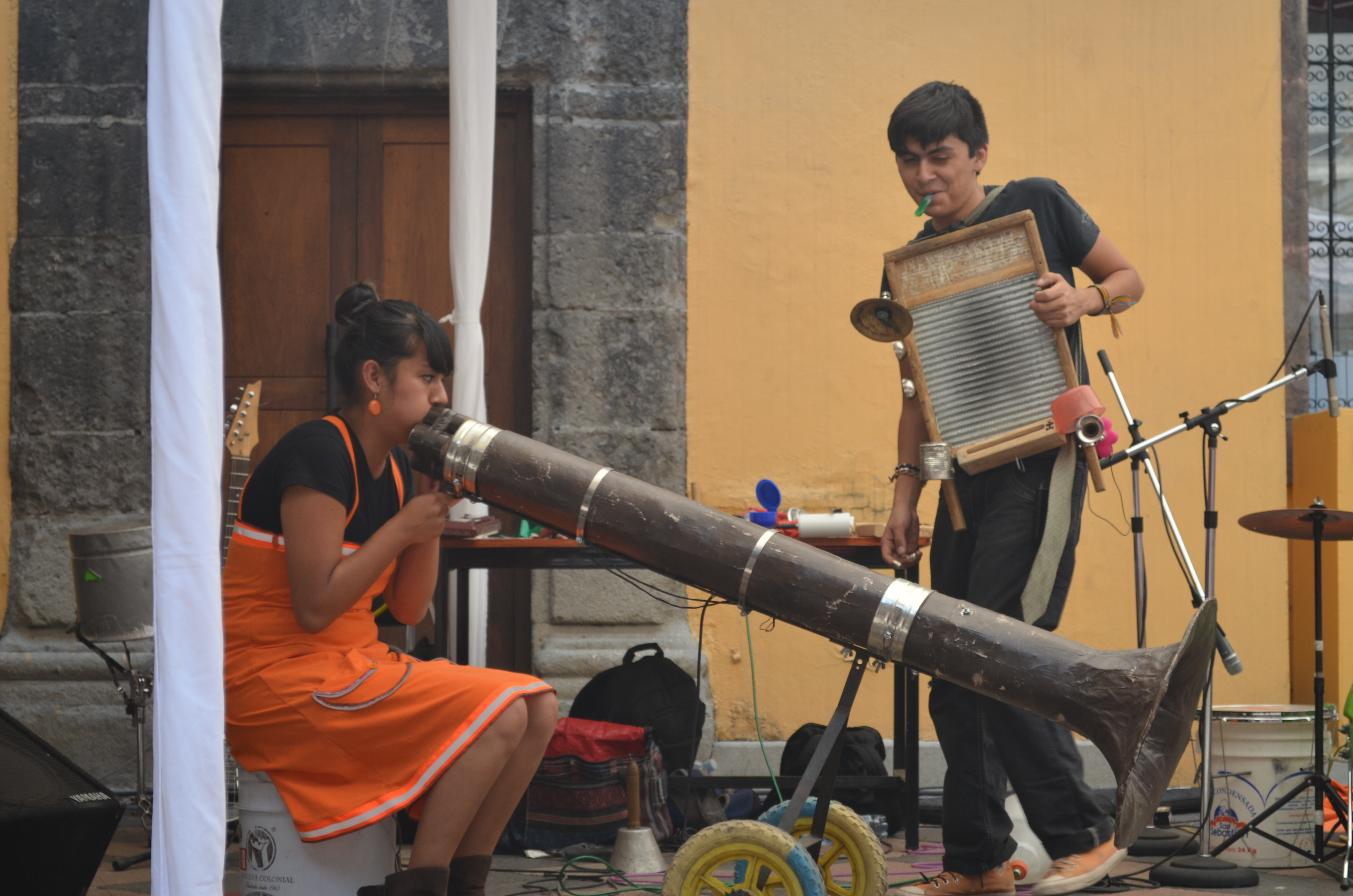
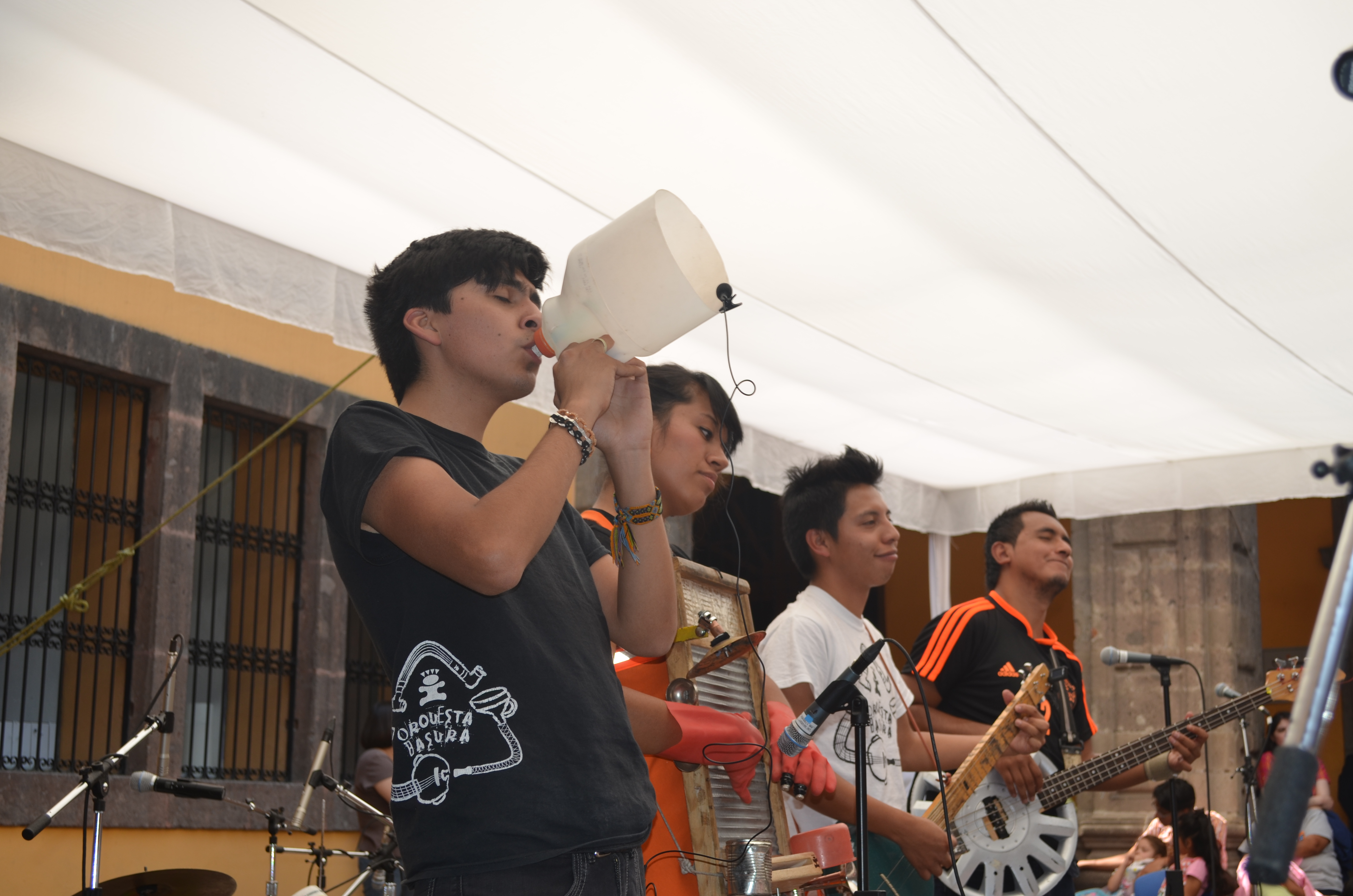
The mighty Orquesta Basura played a free set this weekend at the Antiguo Colegio de San Ildefonso, in Mexico City’s historic center. The capital generates 12,000 metric tons of trash daily, and an estimated quarter-million people make a living of one kind of another off of trash, including pickers, recyclers, haulers–and these four musicians.

They make their instruments out of junk (including the helmet mounted “trompe-cabezas” trumpet, above), and their repertoire is a sweet-smelling salvage job that picks over some of the best semi-forgotten popular dance styles from around the world: tango, gypsy jazz, klezmer, polka, &c. Fitting for a city whose most beloved taco comes from Lebanon.

Here’s the Orquesta playing “Besame Mucho” at a 2011 festival:

Photos: [RF]

WATCHING WASHINGTON

Relatives in Mexico hope for U.S. immigration reform


Originally posted at www.latimes.com:


In Mexico, immigrants’ relatives watch U.S. debate, and hope

Many are skeptical that Congress will pass immigration reform legislation, but if it happens, they say, it will mean the reunion of countless family members, some separated for 20 years.

By Richard Fausset, Los Angeles TimesMay 17, 2013, 5:59 p.m.

TONATICO, Mexico — Armando Guadarrama was navigating his taxi through the narrow streets of this central Mexico pueblo on a recent Saturday morning, some 2,000 miles from the Beltway.

But like many here, Guadarrama was up-to-the-minute with the immigration reform push that is the talk of Washington. When he spoke of its odds, the 40-year-old could sound like a hard-bitten D.C. veteran, grumbling over a scotch at the Old Ebbitt Grill.

He sniffed incredulously at President Obama‘s statement, a day earlier, that he was “absolutely convinced” that reforms would pass this year. Did Obama really think that enough conservative Republicans would fall in line?

“They’re always making promises,” Guadarrama said. “They promised immigration reform” — over and over, he noted — “when I was living up there.”

But if a bill did pass, he emphasized, his family would benefit immeasurably: His older brother, who works in Illinois without a green card, would probably return to Mexico for the first time in 17 years.

The brother was too scared to come back for his father’s funeral in April, because security is so tight at the border. He was afraid he would be caught and deported — forced to give up his American life and paycheck.

Guadarrama’s thoughts summarize the two prevailing sentiments that Washington’s revived immigration reform effort arouses in Tonatico, a small, handsome old pueblo two hours south of the Mexican capital that has sent thousands of its sons and daughters to the U.S. to seek their fortune.

Many here are skeptical of reform’s chances in a polarized Washington. But they also hope they are wrong, because a law with a so-called path to citizenship would allow those who sneaked into the U.S. or overstayed their visas to finally return, without fear, to Mexico and see their loved ones.

“If the law passes, it will change a lot,” said Rafael Aviles, 43, a photographer who lived in Illinois for two decades before a number of run-ins with the law led to his deportation. “People will come back and spend a lot of time with their families. They will relive the life they left. A lot of people haven’t been back in 20 years.”

The details of the Senate’s bill were made public last month by the bipartisan group of eight senators whose proposal would allow those in the country illegally to attain “registered provisional immigrant” status if they pay taxes, fines and fees, pass a criminal check and prove they have lived in the U.S. continuously since Dec. 31, 2011. A small group of House lawmakers reported this week they had reached consensus on a parallel bill. Both bills would be contingent upon various border-security upgrades.

Some immigrants would have to wait as long as 10 years with this “provisional” status before being eligible for a green card. In the meantime, they would be able to work legally in the U.S. and to travel abroad.

That is what matters most in Tonatico, a town of 7,500 that celebrates a “Day of the Absent Migrant” during the annual fiesta that begins in late January. This hilly, long-struggling patch of Mexico has been sending migrants north since the 1940s, when many people here took part in the bracero program launched to help make up for U.S. wartime labor shortages.

When the second great wave of immigration began, in the 1980s, the undocumented were often able to return home without much trouble. They would drive across the border for birthdays, or Mexican Independence Day, or the Tonatico fiesta, then head back to their jobs in the U.S.

Crossing without papers was always a tricky proposition, but it became increasingly difficult after the Sept. 11, 2001, terrorist attacks, when Washington clamped down on the border. More recently, Mexican organized crime groups have targeted northern-bound migrants for extortion, robbery and kidnapping.

Some of Tonatico’s immigrants still come home to visit, but these days it’s only the ones authorized to live in the U.S. Their big trucks, with U.S. license plates, are a common sight on the major holidays.

On the recent Saturday, a white SUV with California plates was parked in front of Tonatico’s graceful, whitewashed church. The car’s owner never appeared, but the evidence of a growing biculturalism, fueled by years of cross-border exchange, was everywhere.

Aviles, the deported photographer, was hanging out in front of the church with the latest camera gear; he said proudly, and in nearly flawless English, that he had learned to use the Internet to shop for cheap electronics when he was in the States.

A few blocks away, Santos Colin Vazquez, 40, was relaxing with his wife and children in the four-bedroom luxury home he built with the money he made while working without a green card, between 1995 and 2004, in a factory in Waukegan, Ill.

Colin came home to Tonatico of his own volition, he said, “because the famous amnesty” — promised in previous failed congressional reform efforts — “never arrived.”

He was asked about the new bill’s chances of passage. “What I hope is yes,” he said. “What I think is no.”

Juan Romero Mendoza, 25, from the neighboring state of Michoacan, said he had worked without a green card as a house framer in Atlanta. Then the real estate market crashed and the work dried up. He returned to Mexico in 2007.

Romero, who was selling homemade furniture on the sidewalk across from the town market, said he was most intrigued by the Senate bill’s proposal to expand temporary guest-worker programs. He said he would love an easy way to make American money, but not have to commit to a full-time life in the U.S.

“The only reason most of us go up there is for un dinerito,” he said — a little money.

In the afternoon, Luis Sotelo, a Tonatico artist and activist, offered a tour of the city’s residential streets, showing how money from newly returned migrants — and remittances from those living abroad — had changed the lifestyles of many families here. Old, tired adobe buildings stood next to buildings with new facades, new additions and fresh coats of paint.

“This one with pesos, this one with dolares,” he said, over and over, pointing from house to house. “The story of Tonatico is written in the houses.”

What was missing, in so many cases, were the very immigrants who had sent the dollars but could not return to see what their dollars had built.

“It’s like a cage,” Aviles said of the immigrants stuck in the U.S. “The gold cage, I call it.”

The Senate immigration bill has sparked what is likely to be a long, messy debate in Washington, with some Republican members of Congress favoring a piecemeal approach to reform. Amid all this, the “registered provisional immigrant” proposal is bound to be one of the most controversial elements: Conservatives have long decried such a move as granting an undeserved “amnesty” to people who cheated the system.

Infighting on Capitol Hill felt both impossibly distant and tragically close that Saturday afternoon on a dusty mountainside outside of Tonatico, in a community called Salinas.

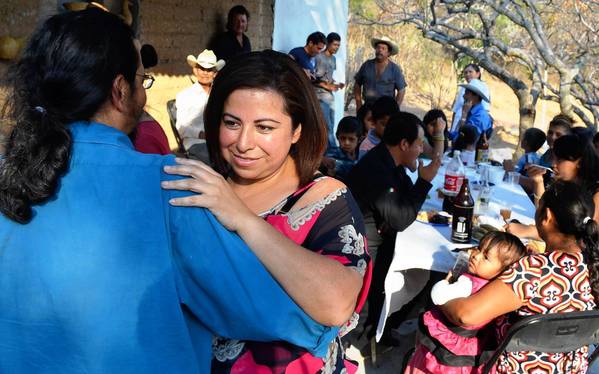
There, by a rustic adobe farmhouse, dozens of friends and family had gathered for a birthday party. The host, Patricia Gutierrez, had spent 11 years without legal status in the United States. Later, she married a U.S. citizen and earned her residency status. Now the professional tax preparer flies back frequently from her home in Nashville, throwing parties for her family at the adobe house she bought for that one purpose.

Sotelo, still playing guide, introduced guest after guest who had a family member stuck in the States. Teacher Josefina Dominguez, 51, said that two of her brothers have legal U.S. resident status. But two of them don’t. They haven’t been home to Mexico in 18 years.

Facebook and other social networks help keep her family connected across the fortified border.

“But sometimes,” she said, “you need to be with your family physically.”

richard.fausset@latimes.com

Times staff writer Brian Bennett in Washington contributed to this report.

Copyright © 2013, Los Angeles Times

Photo: Patricia Gutierrez of Nashville dances at a birthday party in Salinas, outside Tonatico, Mexico. She spent 11 years in the U.S. before she gained legal status, and she now returns regularly to hold parties for her relatives at a house she bought for that purpose. (Richard Fausset / Los Angeles Times / May 4, 2013)

ABOUT MICHOACAN

Mexican President Enrique Peña Nieto's administration focuses on Michoacan state violenceOriginally posted at www.latimes.com:

Mexico names public security chief for Michoacan state

Alberto Reyes Vaca, an army general, will oversee state and federal security forces. His appointment reflects federal concern about drug violence in the state.

By Richard Fausset and Cecilia Sanchez, Los Angeles TimesMay 16, 2013, 6:05 p.m.

MEXICO CITY — Responding to mounting concern about disorder in the Mexican state of Michoacan, officials announced Thursday that an army general would take over as its public security chief, overseeing both state and federal security forces.

The appointment of the general, Alberto Reyes Vaca, was announced by state officials but had been arranged in coordination with the federal government.

For President Enrique Peña Nieto’s administration, the move is part of a promised new focus on the southwestern state, long a hotbed of drug cartel violence. It has been the scene of massacres, paralyzing labor strikes and clashes between new citizen vigilante groups and local officials.

Reyes, a career army officer, is a native of Michoacan who has, among other things, served as commander of a special forces battalion. His predecessor, Leopoldo Hernandez, had held the job for two months.

Interior Minister Miguel Angel Osorio Chong said Wednesday in a preview of the appointment that the public security chief would have the power to control and coordinate state and federal police, as well as federal troops deployed in Michoacan.

“There will be no public security secretary in any part of the republic who will have as much power as he has,” Osorio Chong said in a radio interview.

Peña Nieto’s team has been trying to steer attention away from Mexican security issues while emphasizing the country’s economic potential. Although violence remains a serious concern in many states, Michoacan, along with neighboring Guerrero, has been generating headlines that are particularly difficult to ignore.

In swaths of both states, dozens of “self-defense” groups, usually made up of armed masked men, have emerged, purporting to protect their rural communities from the drug cartels. But recent experiences in the troubled municipality of Buenavista Tomatlan demonstrate how complicated, murky and dangerous the situation has become in parts of Michoacan.

A Buenavista Tomatlan vigilante group formed in February and soon after detained a local police chief and a number of officers, accusing them of criminal connections. The army, in turn, arrested 35 members of the vigilante group in March, alleging they were members of a drug cartel.

This month, a reporter for the newspaper Milenio traveled to La Ruana, a city of 10,000 in the municipality, and found food, gas and medicine shortages, boarded up shops and a population terrified by the presence of a cartel called the Knights Templar. Residents complained that the cartel had stifled commerce in an effort to control the area. A month earlier, in nearby Apatzingan, armed men killed 10 lime pickers. The residents said the government was doing little to help.

On Wednesday night, according to federal prosecutors, federal troops detained 12 members of a self-defense group near the city of Uruapan, confiscating a number semiautomatic rifles.

Some grocery suppliers, including the Bimbo bread company, have said there are regions where the cartels have made it impossible to deliver food. At the same time, angry education students protesting a recently approved federal education reform have reportedly been detaining police officers and stealing trucks and buses, using them to block roads.

The governor of Michoacan, Fausto Vallejo, is a member of Peña Nieto’s Institutional Revolutionary Party. He has been ill for a number of weeks, and the state is being run by an interim governor.

This week, senators of the opposition National Action Party, concerned about the chaos in the state, began working on a proposal that would allow the Senate to replace Vallejo with a provisional governor, who would then call a new election.

richard.fausset@latimes.com

Sanchez is a news assistant in The Times’ Mexico City bureau.

Copyright © 2013, Los Angeles Times

Photo: The Mexican President. [Mandel Ngan, AFP/Getty Images, via LAT]

#LADY

lady

Originally posted at www.latimes.com:

Mexico president fires agency head over restaurant scandal

By Richard Fausset
May 15, 2013, 4:48 p.m.

MEXICO CITY — He’s got to be wishing that  his daughter had just ordered takeout and gone home.

The head of Mexico’s consumer protection agency, Humberto Benitez Treviño, was fired Wednesday by President Enrique Peña Nieto, nearly three weeks after Benitez’s daughter sparked a restaurant scandal that made her Internet infamous and sparked a national conversation about the petulance and lingering sense of entitlement of the Mexican ruling classes.

On April 26, Andrea Benitez Gonzalez tried to score a table at one of Mexico City’s hottest restaurants, Maximo Bistrot, during the Friday lunch rush, even though she didn’t have a reservation. When the staff refused to give her the table she wanted, she threatened to call her father and have the place shut down, according to reports.

Soon, inspectors from the agency, known by its Spanish acronym, Profeco, arrived and alleged that Maximo Bistrot had violated rules regarding reservation policies and the labeling of some of the mescal they served. The daughter, meanwhile, went on Twitter to complain about the lousy service.

But Twitter, in the main, turned against her. As the news broke, other online commenters dubbed her “Lady Profeco.”  Benitez’s face was inserted into satirical cartoons that imagined her calling her father and demanding that he shut down humble taco stands and popsicle vendors. (link in Spanish)

Suddenly, it seemed, Mexican columnists and taxi drivers were discussing the entitlement culture of the Mexican rich and, in particular, the powerful elites connected to the Institutional Revolutionary Party, or PRI, to which Andrea Benitez’s father belongs.

In December, Peña Nieto became the first PRI candidate to be sworn in as president in 12 years. Critics have been concerned that the party, which ruled Mexico in a quasi-authoritarian style for most of the 20th century, aims to turn back the clock, in part by granting favors to a well-connected few.

That criticism appeared to be very much on the mind of Mexican Interior Minister Miguel Angel Osorio Chong on Wednesday when he announced the firing of Humberto Benitez at a news conference. Osorio Chong declared that the although the father “didn’t order or participate in” the incident, Peña Nieto was still letting him go because the case had “tarnished the image and prestige” of the agency.

“With this decision the president of the republic sends a clear message to all of the public servants of the republic … that we are obliged to act in an ethical manner and absolute professionalism,” Osorio Chong said.

Cecilia Sanchez of The Times Mexico City bureau contributed to this report.

POPO

popo

One of the world’s most dangerous volcanoes is rumbling and spewing and generally in a foul mood. Officials in the state of Puebla have opened shelters for potential evacuations. The Onion-like satirical website eldeforma.com has introduced the idea of sacrificing one member of the Mexican congress every hour in an effort to calm Popo.

Photo: CENAPRED


YOSOY LOOKS BACK

yosoy132

The youth-fueled #YoSoy132 movement met Saturday night under Mexico City’s Estela de Luz to celebrate the one-year anniversary of the student standoff with then-candidate Enrique Peña Nieto that triggered a movement that some observers dubbed the “Mexican Spring.” The YoSoy movement put thousands of protesters in the streets after last summer’s elections, who argued that Peña Nieto’s Institutional Revolutionary Party had resorted to vote-buying and other dirty tricks to sway the election in their candidate’s favor.

The spontaneous emergence of a group of millenials clamoring for a more open society and a purer democracy resonated deeply in Mexico, where  slain student protesters during protests in 1968 are considered martyrs and national heroes. At the same time, YoSoy’s media savvy, sense of humor and use of social media suggested that a fresh new political voice had arrived on the scene.

I spent some time with the YoSoy movement last summer, and wondered whether they would be able to sustain momentum. There were formal legal challenges to Peña Nieto’s election at the time, but they ended up going nowhere. And Mexican presidents serve six-year terms — a long time to keep a nascent citizen political movement going.

Last night, the crowd was much smaller than the summer gatherings, but it showed that the movement is not dead. It may only be in hibernation, capable of being awakened by a flurry of tweets.

(No matter what happens to YoSoy–and no matter what you think of their politics–they are, without question, responsible for one of the best Latin American protests songs in recent memory.)

Photo: YoSoy#132 members watch a greatest-hits video of what they’ve achieved, May 11. [RF]

LIMONES

limones

Hauling a Mexico City restaurant’s daily fruit supply, May 10. [RF]