BLANCO

chalk


Drywall hanger, Polanco, Mexico City. [RF]

LA MAESTRA

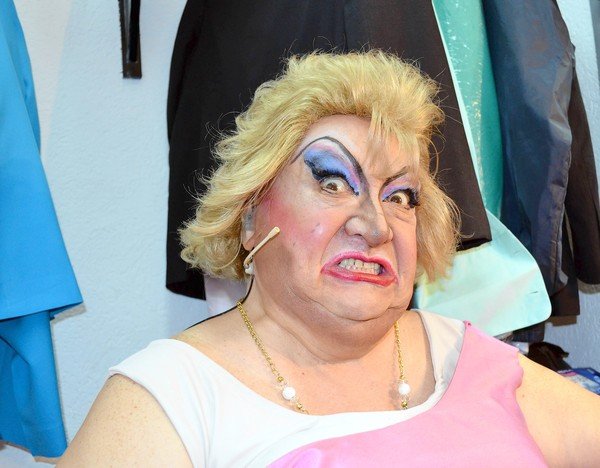
Actor Luis de Alba is ex-union boss Elba Esther Gordillo in Mexican play


Originally posted at www.latimes.com:

An ugly episode in Mexico gets uglier

A nation’s anger over an ex-teachers union boss accused of embezzlement surfaces on the face of comedian Luis de Alba, who plays her in drag.

By Richard Fausset
September 29, 2013, 5:52 p.m.

MEXICO CITY — Actor Luis de Alba sat calm and Buddha-like in a tiny dressing room of the Teatro Blanquita, his eyes closed. A makeup artist, armed with a fat brush dipped in liquid foundation, was painting his broad face with big strokes, as though it were the side of a barn.

It was the first step in transforming De Alba, one of Mexico’s most beloved comedians, into a garish approximation of one of Mexico’s least loved women, Elba Esther Gordillo, the once-powerful teachers union boss whose posh lifestyle erupted in a bonfire of vanities in February, when federal authorities arrested her on charges of embezzlement and organized crime.

It was Friday night. On stage, De Alba’s fellow actors could be heard finishing the first act of their play, “Elba Esther Lost the Case.” Though not every word could be made out from backstage, the attitude came through clear enough. It was a sort of sustained satirical raspberry — broad, cunning, cutting — and soon it would be focused on De Alba’s version of Gordillo, a hot mess of hubris, denial and massive quantities of makeup.

Irma Reynoso, the makeup artist, leaned in close to the actor, applying light and dark base coats in such a way as to lend his nose a sense of dainty angularity. It is an effect the real-life Gordillo is assumed to have achieved with the help of plastic surgery. Going under the knife, prosecutors allege, was one of her favorite ways of spending the roughly $195 million in union funds she is said to have embezzled, along with Neiman Marcus shopping sprees and the purchase of high-end real estate.

Her lifestyle stirred outrage in a country where 45% of residents live below the poverty line. Many Mexicans also blamed Gordillo, at least in part, for the low-performing national education system. And they cringed as national politicians lined up to kowtow to the union boss who controlled the votes of 1.5 million teachers.

Many observers here interpreted Gordillo’s arrest as a way for President Enrique Peña Nieto to clear the path for a sweeping education reform bill that aimed to weaken the teachers unions. The man who replaced Gordillo as leader of the National Union of Education Workers supported the changes. But members of a more radical breakaway union have spent weeks demonstrating in Mexico City, blocking streets and snarling traffic.

Even the Mexican left has been divided over whether the striking teachers deserved support, and the bill, despite all the protest, was approved by Congress this month.

Gordillo, meanwhile, has pleaded not guilty and is awaiting trial in a prison south of town. On Tuesday a federal judge granted her a legal writ meant to protect a defendant’s rights, essentially declaring that federal prosecutors had brought a sloppy case. Prosecutors challenged the document, and Gordillo will remain in prison until the matter is resolved.

She has already been tried in the court of public opinion, however, and her face — artificially pinched, heavily made-up, often scowling — has become one of Mexico’s best-known political memes, a shorthand, to many, of all that is wrong with the country. It appears on T-shirts, as a popular latex mask, and, as portrayed by De Alba, on the posters for the play, which recently completed a three-week tour of Mexico. Producers are hoping to take it back on the road in mid-October.

De Alba, 68, is a longtime Mexican stage and television actor who is best known for having created the character “El Pirrurris,” a send-up of Mexico’s spoiled rich kids. As a rule, he doesn’t like to dress in drag to get laughs. “It’s too cheap,” he says. “Too easy.”

But this play, he said, has given him the chance to offer the audience “a catharsis — of something that was very dramatic for people, disturbing for people, and ugly for the country.”

He says that it is not his job to judge Gordillo: “That’s what the authorities are for.” And yet, over the course of a conversation, the judgment seeped in. He spoke of her “terrible fraud,” of her “interminable” properties, and her infamous surgeries. “They didn’t leave her so pretty,” he said, chuckling. “That’s why they chose me for the role.”

One could argue that the critiques of Gordillo’s appearance are sexist, insensitive or irrelevant. But those arguments aren’t being made in Mexico these days. No one seems to be in the mood.

Reynoso opened two tins of makeup, using them to paint in high-arched, black brows on De Alba’s forehead, framing vast fields of cerulean eye shadow below.

This was the special makeup, she said flatly, that she usually uses only for clowns and monsters.

Ouch.

Next there were fake eyelashes, which the actor dislikes because they impede his vision, and the cream-colored pumps that make it hard for him to walk, and a blond wig, to crown his balding head. De Alba has a wide, roly-poly body, and his Gordillo, now fully realized, bears an uncanny resemblance to Divine, the late American drag queen and cult movie star.

Never heard of him, De Alba said.

Outside, the first act had wrapped, and intermission was ticking down.

The lights came up to reveal the Gordillo character sitting in a chair. She was flanked by two actors who were decked out in fake animal skins and gyrating to tribal drumming. It was an effort, it seemed, to equate the Gordillo face with the proto-Cubist ritual masks of Africa.

There are moments when the Mexican theater chooses to confront the nation’s 21st century predicament with a stark, subtle, Beckettian grace. Tonight would not be one of them.

The cast featured a few scantily dressed women of Barbie-like dimensions, and a little person. There were jokes about bodily functions and sexual acts. A man played a bumbling version of ex-President Vicente Fox, Gordillo’s onetime ally. One scene had them sharing a fictional post-coital chat.

There was a reenactment of Gordillo’s arrest at the Toluca International Airport, and a mock trial, and everyone had their chance to mete out their licks: When the Gordillo character said she would dedicate her body to science, another character shot back: “Science fiction?”

When the house lights came up, the faces in the crowd seemed sated by what they had witnessed. Not justice, but perhaps catharsis.

richard.fausset@latimes.com

Copyright © 2013, Los Angeles Times

 PHOTO: Mexican actor Luis de Alba is the star of “Elba Esther Lost the Case,” a satirical play based on former teachers union boss Elba Esther Gordillo. (Richard Fausset / Los Angeles Times / August 23, 2013)


MASSACRES

Originally posted at www.latimes.com:

In Mexico’s north, second mass shooting in a week leaves four dead


By Richard Fausset and Cecilia Sanchez
September 26, 2013, 3:24 p.m.

MEXICO CITY — Four men were killed and five people seriously injured early Thursday at a bar outside the northern city of Monterrey when assailants burst in and opened fire on patrons, officials with the state government of Nuevo Leon said.

The shooting in the Monterrey suburb of Santa Catarina comes a little more than three days aftergunmen killed 10 people, including a young girl, at a party celebrating the victory of a baseball team near the border city of Ciudad Juarez, in the state of Chihuahua.

The killings are sure to unnerve security officials in the two northern states, as well as their federal counterparts in Mexico City. Earlier this month, Mexican President Enrique Peña Nieto cited Chihuahua and Nuevo Leon as success stories in his government’s effort to restore peace in the nation, noting that homicides had declined in those states by 37.2% and 46.5%, respectively, since he took office in December.

Peña Nieto says homicides nationwide decreased 13.7% between December and July compared with the same period a year earlier. But some independent observers have said they distrust the government’s figures. [Link in Spanish]

Witnesses said the shooting Thursday was carried out by three people  who appeared to be no older than 18, according to Jesus Ignacio Valencia, a spokesman for the Nuevo Leon prosecutor’s office.

Valencia said the trio showed up in a taxi at a place called the Bar Chatos Drink, hurling insults and eventually shooting the place up before fleeing in the same car. The Monterrey newspaper El Norte reported that 40 people were in the bar at the time, taking advantage of a midweek drink special. [Link in Spanish]

Investigators Thursday had “no hypothesis” for the motive of the shooting, Valencia said, though he said it fit a pattern in which organized criminals retaliate against business owners for failing to pay extortion money.

According to state police, one of the slain young men was 17. Police identified four of the five injured victims as men between the ages of 19 and 29. They provided no details about the fifth person.

Metropolitan Monterrey has long been considered an important economic engine for Mexico and was for years considered relatively peaceful. But the city erupted in violence in 2010, after the Zetas, a notoriously violent paramilitary drug gang, split acrimoniously from the Gulf drug cartel, its former employers, and challenged it for dominance in the city.

By some important measures, the situation has calmed recently. State figures show homicide rates have been on the decline both statewide and at the municipal level since 2011.

Mexican security expert Jorge Chabat said the declines can be attributed to the creation of a new state police force, the Fuerza Civil, made up of relatively well-vetted and well-paid officers, and to the weakening of the two cartels.

Chabat said that Zetas aggression hobbled the Gulf cartel, while government arrests and slayings of top Zetas leaders have caused disarray within that group.

Separately Thursday, Mexican news sources reported that three human heads were found in the southwestern state of Michoacan, in an area where drug cartel members are in conflict with self-appointed citizen militias. [Link in Spanish]

Along with the heads was a message threatening any residents who support the militias.

Copyright © 2013, Los Angeles Times

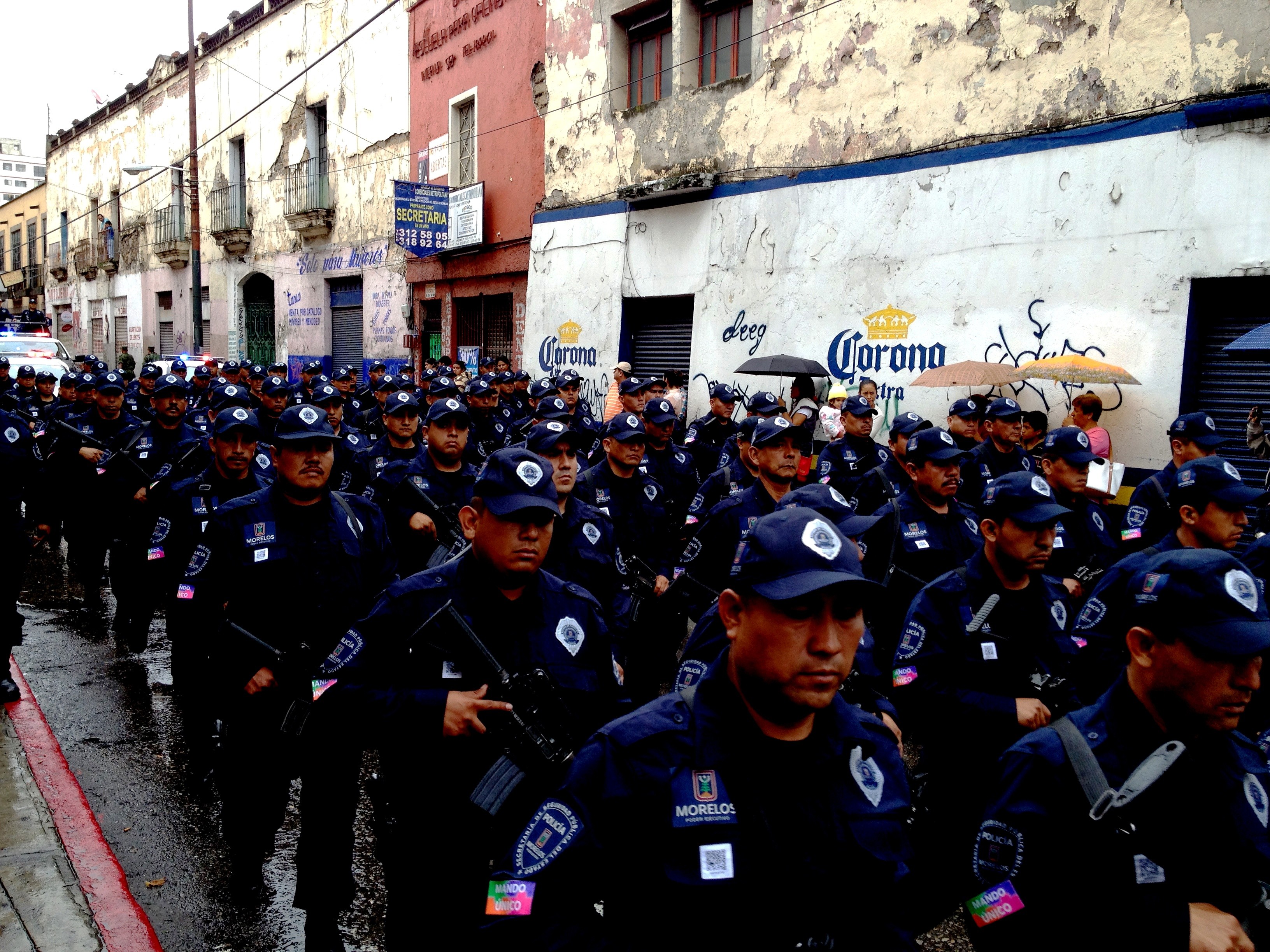
MILLIONS OF COPS

cops

…At least it felt that way. Mexican Independence Day 2013, Cuernavaca. [Photo: RF]

LA CLASE MEDIA

Enrique Pena Nieto unveils fiscal reform plan

Originally posted at www.latimes.com:

Critics say Mexico tax overhaul would hit middle class too hard

Peña Nieto’s fiscal reform plan would impose new taxes on everyday expenses such as rent, schooling, pet food and travel.

By Richard Fausset and Cecilia Sanchez
September 10, 2013, 6:19 p.m.

MEXICO CITY — Ricardo Rodriguez Borja works in a New Age gift store in Polanco, one of Mexico City’s wealthiest neighborhoods, and he readily concedes that its tarot card decks, angel statues and books on chakra energies are luxuries in a country where 45% of residents live in poverty.

The 32-year-old predicts he’ll be making fewer sales if President Enrique Peña Nieto’s fiscal reform proposal is approved, because of the added tax burden it will place on his middle-class customers. Rodriguez figures he’ll be affected personally as well, forced to pay additional taxes on rent, entertainment and bus trips out of town.

“It’s a chain-reaction effect,” he said Tuesday. “I’ll make less, and have less to spend at other businesses.”

Peña Nieto’s plan, unveiled Sunday, seeks to raise more revenue in a country that has the lowest tax-collection rate of any of the 34 nations in the Organization for Economic Cooperation and Development. The president sought to avoid the wrath of the Mexican left by leaving out, apparently at the eleventh hour, a value-added sales tax on food and medicine.

But critics on both the left and the right say the plan piles too much of the tax burden on the middle class.

“We are concerned,” said Juan Pablo Castañon, president of the Employers Confederation of the Mexican Republic, a leading business group. The headline writers for the website of Proceso, the muckraking leftist magazine, were less polite, calling Peña Nieto the “hangman of the middle class.”

The proposal would raise the top income tax rate from 30% to 32% for workers earning about $38,000 per year, and impose new taxes on a number of everyday expenses, including private school tuition, pet food, plane trips, gas and soft drinks. The newspaper Reforma on Tuesday calculated that someone with two children and a pet could see expenses jump by about $260 a month.

“There’s no question there’s a [significant] burden on the middle class,” said Fred Barrett, a tax partner at PricewaterhouseCoopers in Mexico City.

The Mexican legislature is set to consider Peña Nieto’s proposal at a time when the country’s economy is experiencing sluggish growth, and as observers in and out of Mexico spar over whether the country has transformed from a largely poor to a “middle class” one, an argument that affects not only the national identity, but also national policy priorities.

A report this year by Mexico’s National Institute of Statistics and Geography suggested that the country was both, with 59% of Mexicans categorized as “lower class” and 39% of them “middle class.” (About 2% of the population was determined to be “upper class.”) The institute found that the middle class grew by about 4% from 2000 to 2010.

Barrett said the president’s plan would hammer the middle class in more indirect ways by scaling back tax exemptions for home sellers, companies that offer healthcare and other benefits to employees, and the border-region factories known as maquiladoras. “Who do you think runs the maquiladoras?” Barrett said. “The middle classes.”

He said the president’s proposal could have done more to tackle the problem of the so-called informal economy — those businesses outside the purview of government, such as some taco vendors, maids and multi-employee small businesses — which comprises nearly 6 in 10 Mexican workers. Among other things, the president is hoping workers will be lured into the formal economy by the promise of qualifying for social security benefits.

Rodriguez said he didn’t understand why the president didn’t propose placing an additional tax burden on Mexico’s rarefied caste of millionaires and billionaires. The existence of a “Mexican middle class,” he said, is akin to how some view angels and chakras.

“It’s a myth,” Rodriguez said. “In Mexico, it’s just the upper class and the rest of us.”

richard.fausset@latimes.com

Sanchez is a news assistant in The Times’ Mexico City bureau.

Copyright © 2013, Los Angeles Times

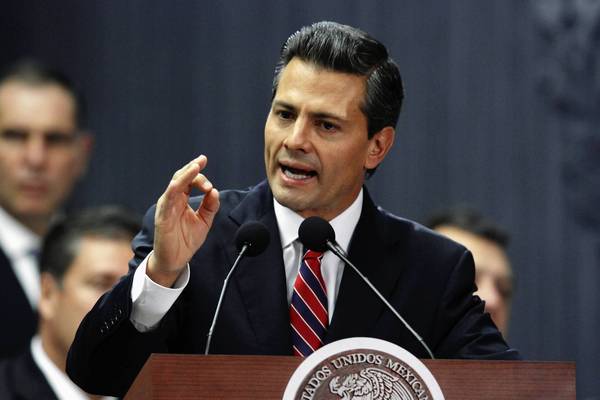
Photo: Mexican President Enrique Pena Nieto unveils his fiscal reform plan on Sunday. He left out, apparently at the eleventh hour, a value-added sales tax on food and medicine. (Marco Ugarte / Associated Press /September 11, 2013, via LA Times)


THE PLAN

BLM_MEXICO TAX REFORM


Originally posted at www.latimes.com:

Mexico plan to boost welfare spending raises concerns

The proposal may boost Pena Nieto’s populist credentials, but fiscal conservatives fear deficits.

By Richard Fausset and Cecilia Sanchez
September 10, 2013, 6:00 a.m.

MEXICO CITY — With a new fiscal reform proposal that tacks decidedly left, Mexican President Enrique Peña Nieto appears to be seeking to cool the ardor of progressive critics who have taken to the streets by the thousands to protest his ambitious reform agenda and accuse him of being unconcerned about the plight of the poor.

The plan, which the president unveiled Sunday night, seeks to boost welfare spending and shield the poor from tax increases by continuing to exempt food and medicine from a value-added sales tax, or VAT. Though it may serve to burnish Peña Nieto’s populist credentials, it is also causing concern among fiscal conservatives who remember how profligate spending by his Institutional Revolutionary Party, or PRI, was a factor in numerous financial disasters the nation suffered under its past rule.

“Mexicans have already learned that indebtedness is a false exit and if it is irresponsibly managed, it can result in a bust,” said a statement released Monday by the conservative National Action Party, or PAN.

The president Sunday referred to his package as a “social reform” that would create a progressive tax structure and expand the Mexican social safety net. Though PRI leaders had hinted earlier that the package would include a VAT for food and medicine, the president said he chose not to include those tax hikes because the Mexican economy was growing “less than expected.”

“At this moment, it would have an adverse effect on consumption and the welfare of the people,” he said.

The idea that Peña Nieto planned to raise taxes had become a key talking point of his most vocal critic, Andres Manuel Lopez Obrador, the leftist leader who ran second in the 2012 presidential election. On Sunday morning, roughly 50,000 Mexicans joined Lopez Obrador in a rally downtown to protest another major Peña Nieto proposal that seeks to open the struggling national oil company, Pemex, to foreign investment.

Proponents of the energy proposal say it is crucial to boosting Pemex’s declining production — and also necessary for Mexico’s overall economic health, since the company provides a third of the government’s revenue. Critics like Lopez Obrador see it as selling off the country’s most important natural resource.

In his speech, Lopez Obrador warned, as he has many times previously, that the president was going to have to raise taxes to make up for the oil revenue that would, under the energy proposal, go to foreign companies rather than government coffers.

“They are proposing that Mexicans pay the bill for the delivery of petroleum profits to foreigners,” he said.

Peña Nieto is hoping his fiscal plan will boost revenue in a country that collects less than any other nation in the 34-member Organization for Economic Cooperation and Development. But in place of the VAT on food and medicine, he proposes closing a number of business tax loopholes; taxing stock market gains; and raising income taxes on Mexicans making $38,000 a year — from 30% to 32%.

Overall, it appears that the president is hoping to place the burden of new revenue largely on businesses, rather than on the working and middle classes, said Rogelio Ramirez de la O, a Mexico City economist who has advised Lopez Obrador on economic issues.

At the same time, Peña Nieto has proposed expanding the social security system to cover more older Mexicans, and creating a new unemployment insurance program — both of which were proposals supported by Lopez Obrador.

Ricardo Aleman, a columnist for the newspaper El Universal, wrote Monday that these stances had created a “severe dilemma” for Lopez Obrador and the president’s other critics: How, he said, could they now “summon society to combat and reject proposals that the left has championed for decades?”

Lopez Obrador recently broke from the main leftist party, the Democratic Revolution Party, or PRD. On Sunday evening, PRD leader Jesus Zambrano hailed Peña Nieto’s budget for “putting the accent on the grand themes of social inequality.”

Both Zambrano and Gustavo Madero, the head of the conservative PAN party, accompanied the president as he announced his plan Sunday night; both parties have entered with the PRI into a “Pact for Mexico” that seeks agreement on the basic outlines of various reforms.

But while Madero applauded on Sunday, his party a day later issued its statement raising concern about spending. Under the two PAN presidencies, from 2000 to 2012, low deficits were considered major achievements after the deficit-fueled crises the country suffered during the PRI years, most recently with the peso crash of 1994.

Peña Nieto promised a balanced budget for 2013 when he took office in December. Under the new program, he said, the deficit would rise to 0.4% of gross domestic product for 2013, and 1.5% of GDP for 2014.

Those numbers are in line with previous deficits under the PAN. But Ramirez, the economist, said that with all of the programs Peña Nieto is proposing, his team may soon run up an even greater deficit — unless they add the VAT to food and medicine.

“I don’t see any other way for them to do it,” Ramirez said. “I really don’t.”

richard.fausset@latimes.com

Sanchez is a news assistant in The Times’ Mexico City bureau.

Copyright © 2013, Los Angeles Times

Photo: Mexican President Enrique Pena Nieto speaks about his fiscal plans for the nation. (Susana Gonzalez / Bloomberg / September 8, 2013, via LA Times)


THE CRITICS

APphoto_Mexico Protest

Originally posted at www.latimes.com:

Tens of thousands protest Mexican oil reforms

By Richard Fausset
This post has been updated, as indicated below.
September 8, 2013, 8:51 p.m.

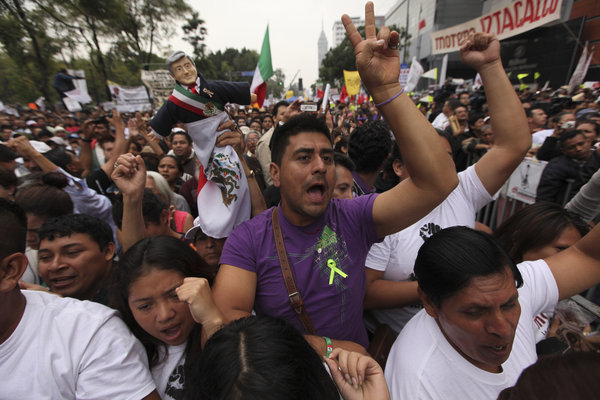
MEXICO CITY — Tens of thousands of Mexicans jammed the center of their capital city Sunday to protest President Enrique Peña Nieto’s plan to allow foreign firms to invest in and collaborate with the state-run oil company, whose independence from outside influence has been a source of national pride for decades.

The city government estimated that 44,000 people crowded downtown’s Avenida Juarez to hear the anti-reform arguments of Andres Manuel Lopez Obrador, the two-time presidential candidate and de facto leader of the Mexican left.

Although reform supporters appear to have enough votes in congress and state legislatures to approve the proposal, which requires a constitutional change, Lopez Obrador insisted Sunday that a popular uprising, if large enough, could stop the plan in its tracks.

“I am sure we are going to stop these anti-patriotic reforms,” Lopez Obrador said, standing in front of a three-story sign that read: “NO TO THE ROBBERY OF ALL TIME.” He added: “Don’t let anyone think it’s not possible.”

Peña Nieto took office in December, and the overhaul of the Mexican oil industry is arguably the most important proposal in his ambitious reform agenda. It was also bound to be the most controversial. President Lazaro Cardenas kicked foreign oil companies out of the country in 1938 after years of what many here believed to be exploitative behavior. The Mexican constitution currently declares that all oil and gas is the property of the Mexican people, and the 1938 expropriation is celebrated yearly with a national holiday.

Today, however, even many nationalists and leftists concede that Petroleos Mexicanos, or Pemex, the state oil company, is a corrupt and inefficient behemoth. Pro-reform forces believe that foreign companies could help Pemex reverse declining production by applying their capital and expertise to deep-water and shale oil ventures.

Lopez Obrador argued Sunday, as he has previously, that Pemex needed to be cleansed of corruption, not opened to outside investment. He portrayed the reform as part of a 30-year wave of privatization that has enriched a privileged few while doing little to help everyday Mexicans.

He also said he expected tax increases to be part of Peña Nieto’s tax reform plan, which was scheduled to be unveiled Sunday night; Mexicans, he argued, were being forced to “pay the bill for the delivery of oil profits to foreigners.”

[Updated at 8:51 p.m. Sept. 8: Lopez Obrador had previously warned that the change would include new sales taxes on food and medicine. But Peña Nieto’s proposal, released Sunday evening, did not include new taxes on most food and medicine. It would raise some taxes for wealthy Mexicans, as well as some levies on specific consumer items such as soft drinks.

Peña Nieto also aims to enlarge the social safety net by expanding a pension program for retirees and offering up to six months of unemployment insurance. In the past, Lopez Obrador has championed those ideas.]

Peña Nieto’s team has launched an aggressive advertising campaign that states that their reform does not amount to “privatization” of Pemex. On Sunday, the protesters — a spirited but peaceful bunch that included students, retirees and all ages in between — were having none of it.

“The patria [native land] is not for sale!” they chanted. “We love it and defend it.”

“A government or individual who sells natural resources to foreign countries betrays the country,” one sign read. “The people are not stupid,” said another.

Miguel Angel Soriano, 18, a recent high school graduate, didn’t understand why reformers thought foreigners could do a better job extracting oil and gas than Mexico’s homegrown engineers.

“To say that we don’t have the expertise here in Mexico is an insult to UNAM and the Politecnico,” he said, referring to to the National Autonomous University of Mexico and the National Polytechnic Institute, two of the country’s best-known universities.

After his second-place finish in last year’s elections, the silver-haired Lopez Obrador quit the leftist Party of the Democratic Revolution, or PRD, and formed his own group, the National Regeneration Movement, or Morena. The PRD is planning a protest for Sept. 15, and Lopez Obrador said he will call his supporters back in the streets on Sept. 22.

The capital has already been overrun with demonstrators for weeks, thanks in large part to a teachers’ union whose members have camped out in the zocalo, or central square, to protest Peña Nieto’s education reform proposals. Though the last element of the reform was approved by congress this week, the teachers have said they plan to continue their street demonstrations indefinitely.

Because the teachers refused to dismantle the sprawling tent city they have erected in the zocalo, Lopez Obrador was unable to hold his protest there, as planned, instead moving the rally a few blocks away.

Photo: Supporters of former presidential candidate Andres Manuel Lopez Obrador cheer as they listen to him Sunday during a demonstration in Mexico City against the government’s proposed energy reforms that would allow private companies to explore the country’s oil and gas reserves. (Marco Ugarte / Associated Press / September 8, 2013, via LA Times)

THROWING PUNCHES

women boxers

Above: Women practicing their boxing moves Saturday at Mexico City’s Parque America. (Click photo to enlarge.) The issue of violence against women — and retaliation against such violence — was back in the news this week in Mexico in a strange and dramatic way.

My colleagues Tracy Wilkinson and Cecilia Sanchez reported on the alleged presence of a female vigilante in Ciudad Juarez who “dresses in black, has unusually blond hair — and kills bus drivers who sexually assault women.”

[Photo: RF]

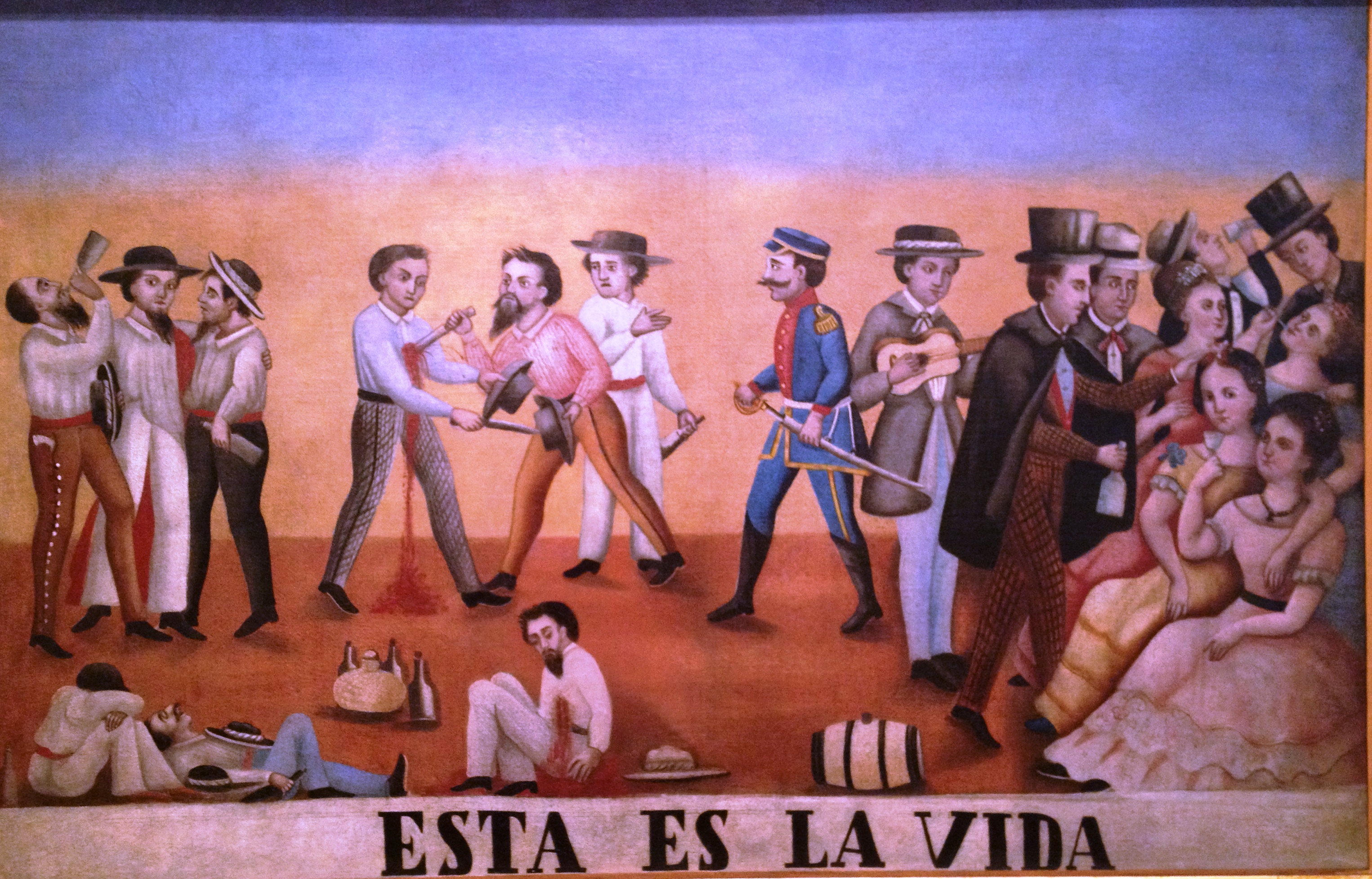
THIS IS LIFE

esta es la vida NEW

Sex, blood, liquor, death, treachery, guitars: Wondering if this anonymous 19th Century Mexican painter left anything out. (Click to enlarge!)

[Photo: RF, from Mexico’s National Museum of Art.]

THE ADVOCATE

#130606blog


Originally posted at www.latimes.com:


Mexico’s Vicente Fox pushes marijuana debate to forefront

Conservative former President Vicente Fox has become an unlikely leading advocate of marijuana legalization. He says his change of heart stems from Mexico’s mounting drug violence.

By Richard Fausset
September 2, 2013, 7:49 p.m.

SAN CRISTOBAL, Mexico — Former President Vicente Fox grew up on a farm here in rural Guanajuato, one of Mexico’s most conservative states. He is the kind of guy who wears big belt buckles, collects hand-tooled saddles and worships the free market.

Ask him about his experience with the drug culture and the big man with the cowboy-movie mustache exhibits a kind of straight-laced pique: Never smoked pot, he says. Hardly knew anyone who did.

But Fox has always fancied himself a policy maverick. And these days, the former standard-bearer of Mexico’s conservative National Action Party, or PAN, has emerged as one of Latin America’s most outspoken advocates of marijuana legalization.

Fox, 71, came out for legalization a few years ago. But this summer he has significantly ramped up his efforts. In June, he declared that he would grow the plant if it were legalized — “I’m a farmer,” he said — and added that he’d like to see marijuana sold in Mexican convenience stores.

Some see him as a visionary, others as a cynical promoter milking the issue for attention (and, perhaps, lucrative speaking fees). Many think he’s simply nuts. In a poll published in the liberal Mexico City newspaper La Jornada, 43% of respondents agreed that the former president “had finally gone crazy,” while 32% said he should be investigated for promoting criminality. Only 11% said he had the right idea.

It was an unsurprising response from the Mexican left, who have long considered Fox to be a rash bumpkin with an embarrassing history of speaking before thinking. But these days, it is arguably the right-wing Fox who has done the most to promote this pet cause of the left and finally force a serious debate in the Mexican mainstream.

Fox speaks like a true believer about legalization’s potential to save his troubled country, at times lapsing into the giddy visionary jargon of online TED talks: It would be a “game-changer,” he says, “a change of paradigm.”

A month after his pot-growing comments made international headlines, Fox built momentum for the cause with an attention-grabbing legalization symposium at his presidential library, the Centro Fox, here in the farming town where he grew up.

Since then, the national discussion has grown considerably. Mexican TV and newspapers are suddenly rife with articles debating the pros and cons. The mayor of Mexico City, Miguel Angel Mancera, has reiterated his promise to debate legalization in the left-leaning capital. More recently, the liberal governor of Morelos state, Graco Ramirez, said he would push to ease marijuana restrictions in his state.

Though Mexican President Enrique Peña Nieto opposes the idea, it now seems possible that the nation might follow the pattern of the United States, where residents of Colorado and Washington voted to legalize recreational marijuana use, despite the continuing opposition of the federal government. The Mexican Congress decriminalized the possession of small amounts of marijuana in 2009.

Fox favors the eventual legalization and regulation of all drugs in Mexico. The idea is to rob the bloodthirsty drug cartels of their profits and power. Legal pot, he says, would be the first step.

“This prohibition is the last frontier of prohibitions,” Fox told The Times during a break in his July symposium. Revealing a marked libertarian streak, he argued that government efforts to regulate other personal behaviors had been found wanting: “The issue of abortion. The issue of same-sex marriage. The issue of gays. The issue of alcohol,” he said. “These arbitrarily imposed prohibitions have ended. And they have ended because they don’t work.”

Across Latin America, there is a growing frustration with long-standing U.S.-backed prohibitionist drug policies. Several current and former heads of state in the region have, like Fox, declared their support for marijuana legalization — declarations that would have been considered unthinkable just a few years ago.

One of the most significant cracks in the previous drug-war consensus came in late July, when Uruguay’s lower house of parliament approved a landmark marijuana legalization bill. Observers say it has a good chance of becoming law.

During his 2000-06 presidency, Fox was a prohibitionist. But now, he says, he doesn’t see any sense in Mexico fighting domestic pot growers when the legalization trend appears to be picking up steam in the U.S., where Mexico sends about 40% to 70% of the marijuana it grows.

His change of heart took place during the six-year term of his successor, Felipe Calderon, who launched a military-led crackdown on Mexico’s drug cartels. From 2006 to the end of Calderon’s term late last year, an estimated 70,000 Mexicans died, and thousands more disappeared — what Fox today calls a “butchery” and a “gully of blood.”

Fox’s friends say he was affected by the Calderon era. “I think Fox is a religious person, and he is a humanist,” said Ruben Aguilar, Fox’s former spokesman. “He lives with a lot of sadness over the deaths in those last six years.”

Calderon, for his part, has said that he launched the offensive because he discovered, after winning the election, that Mexico’s criminal groups had become frighteningly powerful, and that the institutions charged with fighting crime were, in many cases, mixed up in it.

Embedded in such comments is an implicit critique of Fox’s leadership, and it reflects the broader criticism that some other observers level against him: that he accomplished little of note after the milestone 2000 election in which he vanquished the Institutional Revolutionary Party, or PRI, which governed Mexico in a semi-autocratic fashion for more than 70 years.

Aguilar defended Fox’s record as president and noted that he has always been more popular with the Mexican mainstream than with the left and the news media. Even so, it will be a challenge for Fox to sell the idea of a radical shift in drug policy to ordinary Mexicans. In a poll released last month by the research firm GCE, nearly 50% of Mexicans said they were “totally opposed” to marijuana legalization, while about 14% said they strongly favored it. The rest fell somewhere in between.

Unease with the idea is almost palpable. Former presidential candidate Andres Manuel Lopez Obrador recently called the legalization debate “a smoke screen” detracting from more important issues including the economy and corruption.

Fox has already changed the Mexican status quo once. Many would agree that his 2000 presidential victory was the catalyst for a new era of democratic governance. The fact is not lost on him. Hanging in the main room of his glass and concrete library are a series of large banners honoring visionary thinkers including the Rev. Martin Luther King Jr. and Mohandas K. Gandhi.

There is also a banner of Vicente Fox.

The library is the first of its kind in Mexico, and Fox takes pride in the fact that, unlike other Mexican ex-presidents, he has stayed involved in the public debate, enjoying the freedom to speak his mind, with little concern for political taboos.

He’s certainly caused his share of trouble. Last year, his own party threatened to kick him out after he endorsed Peña Nieto, the PRI candidate, for president. Fox said he simply thought Peña Nieto was the best candidate. PAN leaders said they would expel him, but he quit the party before they could do so.

In Oaxaca this summer, the city council officially declared him persona non grata after he proclaimed that he had been a better president than Benito Juarez, the Oaxaca-born 19th century president who is perhaps Mexico’s most revered political hero.

Criticism came from all sides, but Fox did not back down. As the first day of the drug symposium drew to a close, he could be found making an extended case against Juarez for the benefit of a Mexican TV reporter.

There were more reporters, and many more questions, but eventually the ex-president called it a day. He walked from his presidential library to his family’s graceful old hacienda, now converted into a luxury hotel.

He sidled up to the bar and ordered that least controversial of Mexican psychoactive substances: a cold Corona.

Copyright © 2013, Los Angeles Times

[Above: Vicente Fox, as rendered by Guadalajara cartoonist Pacote.]