Author: rfausset

DRIVE

Learning to drive in Mexico City


Originally published at www.latimes.com:

Driver’s ed in Mexico City: White knuckles all the way

Mexico City doesn’t require adults to pass an exam for a driver’s license, but there are driving schools for ‘nervous people’ who are afraid of the wild roads.

STORY AND PHOTOS BY RICHARD FAUSSET

REPORTING FROM MEXICO CITY

June 12, 2013

Pedro Cervantes was speaking with his teaching voice. It was clear and almost mystically calm — the kind of voice you’d want talking you through the emergency landing of a passenger plane:

This is the steering wheel, he said. Hands at 10 and 2. This is your gas gauge.

Cervantes was in the passenger seat of a red, four-door Nissan compact from the Harvey Driving School, giving Patricia Sanchez, 52, her first lesson in how to drive.

Or, more specifically, how to drive in Mexico City, a seemingly infinite maze of daredevils and incompetents, of axle-bending potholes and curb-hugging taco stands, of signless seven-way intersections and baffling multidirectional traffic circles, of tamale vendors on tricycles and cops hungry for bribe money.

It’s a place with 4.5 million motorized vehicles, a place where someone is killed or injured in a traffic accident every hour, yet adults don’t have to take any sort of exam to receive a driver’s license.

But Sanchez, a retired social security agency worker, soft-spoken, with pink lipstick to match her nails, was looking for some peace of mind.

On the side of Cervantes’ Nissan, blocky yellow letters spelled out: “ESPECIALISTAS EN PERSONAS NERVIOSAS.” Specialists in nervous people.

This is the lever for the turn signal, he told Sanchez. This one works the wipers. Here are the pedals: El clutch, el freno, el acelerador.

“Sale?” he asked her. Got it?

“Mmm-hmmm,” she replied, unconvincingly.

“Muy bien.”

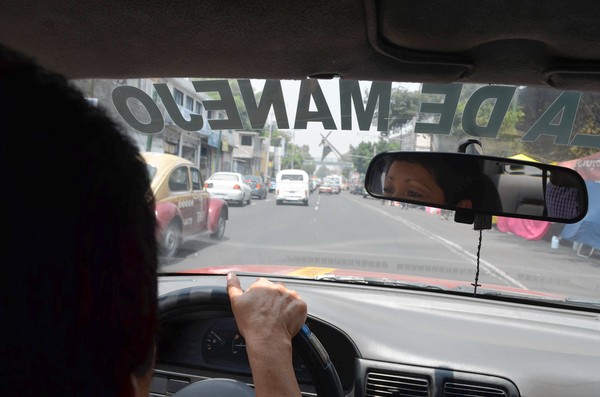
A car from Escuela de Manejo Harvey, or Harvey Driving School, advertises the company as “ESPECIALISTAS EN PERSONAS NERVIOSAS” (specialists in nervous people). 

In Mexico City, driver’s exams for adults were phased out in 2001 after widespread corruption was discovered among test administrators. These days, aspiring license-seekers can simply show up at a government office with an ID, proof of residence and 626 pesos, or about $50.

City officials recently announced that an exam of some kind will again be required for adult applicants next year. That should be good for business at the capital’s 29 licensed driving schools. For now, many of their customers are adolescents, who must show they took a driving course to qualify for a license. The rest are adults like Sanchez, the personas nerviosas.

She had paid 1,000 pesos, or about $80, for three two-hour lessons, consisting of a one-hour review of the controls, five hours of hands-on driving and a photocopied sheet of paper with basic, seemingly random tips: “Don’t look at airplanes,” “Don’t put your faith in good luck.”

Traffic laws were not part of the curriculum, Cervantes said. There simply wasn’t time.

Basically, it is “a course in how to survive,” the instructor said, laughing.

As the first hour came to an end, Sanchez still had a basic question. “So I put in the clutch when I hit the brakes?”

Minutes later, Cervantes was telling her to turn the key and urging her to let out the clutch slowly.

Derechito, derecheeeeto,” he said. Roughly translated as: Straight ahead. Nice and easy.

It’s unclear whether the return of the driving exam for adults will have any effect on Mexico City’s driving culture. What would be considered bad driving in other countries — the rule-bending, bumper-riding and lane-drifting — is simply business as usual here.

Locals turn to a specialized vocabulary to describe the most egregious scofflaws. A poor driver here is a cafre. To threaten to change lanes with wanton disregard for the cars around you — essentially, threatening them with an accident if they don’t move — is to echar lámina, or throw one’s metal around.

Pedro Hoth, Mexico City’s former international affairs coordinator, believes that Mexico City’s driving style is rooted in the age of conquest, when only the Spanish and their allies had the right to ride a horse. Having a horse meant having a special claim to power.

“Today the automobile is the substitute for the horse, but the attitude is the same,” Hoth wrote in a recent email. “It’s a kind of Jekyll and Hyde syndrome, this arrogance that many drivers experience once they get behind the wheel. The inside of the car becomes a space of arbitrary power.”

The plan to reintroduce the driving test is part of a broader, dawning sense that the problem has careened out of control. In the last few years, the city has undertaken a successful anti-drunk-driving initiative, setting up roadblocks called alcoholimetros.

An old photograph of cars entering a traffic circle on Mexico City’s main avenue, Paseo de la Reforma. (Jose Luis Magana / Associated Press, via Los Angeles Times)

After an out-of-control gas truck crashed and exploded May 7, killing 26 residents of suburban Ecatepec, newspaper columnist Sergio Sarmiento suggested that Mexicans, who are understandably fixated on the drug-cartel-fueled culture of violence in the country, should also focus on the culture of negligence. In 2011, more than 27,000 people died in violence in Mexico, government statistics show. That same year, more than 36,000 Mexicans died in various kinds of accidents — about 16,600 of them traffic accidents.

Patricia Sanchez’s plan had always been to leave the driving to someone else. For years, she commuted to work in a cab. Her apartment in the working-class neighborhood of Iztapalapa is just a couple of blocks from a Chedraui, Mexico’s homegrown big-box store. When she needed to venture farther afield, she took the subway or asked for rides from members of her large extended family.

But some of her chauffeur relatives have become busy of late, and Sanchez realized that she needed to learn how to drive. She was encouraged by the fact that she had successfully learned how to swim in her late 40s. Her daughter gave her the money for the driving lessons as a Mother’s Day present.

She liked Pedro Cervantes’ smooth, measured way of talking her through things. Her ex-husband had tried to teach her to drive years ago, she said, “but he always ended up yelling at me.”

Now she was rolling down one of Iztapalapa’s quieter streets, feeling out the interplay of clutch and gas while going about 5 mph.

Derechito, derecheeeeto,” Cervantes said. She stalled out on a speed bump with a violent jerk.

And so it went, Sanchez stalling her way around Iztapalapa. She stalled in front of taco stands and fruit vendors, in front of a group of schoolgirls in plaid skirts walking home. She stalled at a five-way intersection with no stop signs, giving her fellow drivers an unintentional sign that it was safe for them to go ahead of her. She stalled on her narrow, two-lane street, inexplicably scarred down the middle with a 6-inch-deep gash.

Cervantes helped her park the car. “Any doubts I can help you with?”

“I don’t think so,” she said.

Good, he told her. Tomorrow, the real test: the rest of the city.

The next day, she was so nervous she had a stomachache. She had read about the gas truck accident. (Prosecutors alleged the driver was a speeding cafre; the driver alleges he was forced to swerve to avoid a bus driver who was echando lámina, throwing metal.)

Driving instructor Pedro Cervantes teaches Patricia Sanchez, 52, the basics in Mexico City’s Ixtapalapa neighborhood.

Sanchez waited for Cervantes on the curb of her chewed-up street. He arrived on time and had her get behind the wheel. Soon they were off, shifting into higher gears, toward the imposing, anarchic, eight-lane arteries of Iztapalapa.

She was still struggling with the rhythm of the clutch, and it bothered her. But little else did.

The novelist David Foster Wallace once told a joke about a pair of fish who were asked how the water was today.

“What the hell is water?” one of the fish asked.

Sanchez has never lived anywhere but Mexico City. For the next two hours, the green peserominibuses would jockey within millimeters of her back bumper. A spiky-haired kid in wraparound sunglasses, in a lane to her right, would turn left in front of her at an intersection. Transfer trucks would roar on all sides. A man in a Ford Fusion would direct unprintable words her way as he raced past her passenger-side flank.

Junk-food delivery motorcycles whirred between lanes, bicyclists appeared suddenly from between taco-stand tarps. Everywhere, the city sidewalks would scream for her attention, advertising tire repair, insurance for sale, pastries, tailors, butchers and all of the homemade riches from the griddles of the street: tlacoyos, pambazos, sopes, huaraches.

Bone-rattling speed bumps arrived unannounced. The paint marking the lanes faded to black, reappeared and faded again.

Derechito,” Cervantes told her as she navigated calmly through it all. “Derecheeeto.”

Cecilia Sanchez and Karla Tenorio Zumárraga of The Times’ Mexico City bureau contributed to this report.

SERENATA

We had been driving around the back roads of Chiapas long enough to consider ourselves friends. At one point he parked the taxi in front of his little house in Tuxtla Chico and introduced me to his wife, who gave me God’s blessing. But now we were winding up into the mountains toward a place called Union Juarez, in search of a thing we would end up not finding.

He was happy. Happy that a gabacho was in his cab, one who was paying him well for his time, happy to be heading up to the mountains, closer to the cool, deep gray of the sky, away from the sick jungle heat of the flats.

We came to a lull in the conversation. Wires were hanging out of the cavity where his tape deck should have been. So he sang Jose Alfredo Jimenez:


Por tu amor, 
que tanto quiero, 
y tanto extraño 

Que me sirvan 
otra copa y muchas más 
que me sirvan 
de una vez 
pá todo el año 
que me pienso 
seriamente, emborrachar 

Si te cuentan 
que me vieron 
muy borracho, 
orgullosamente 
diles que es por ti, 
porque yo tendré 
el valor de no negarlo 
gritaré que por tu amor 
me estoy matando 
y sabrás 
que por tus besos 
me perdí 

Para de hoy en adelante 
ya el amor no me interesa 
cantare por todo el mundo, 
mi dolor 
y mi tristeza 

Porque se 
que de este 
golpe 
ya no voy a levantarme 
que yo no lo quisiera 
voy a morirme de amor 

MISERICORDIA

misericordia


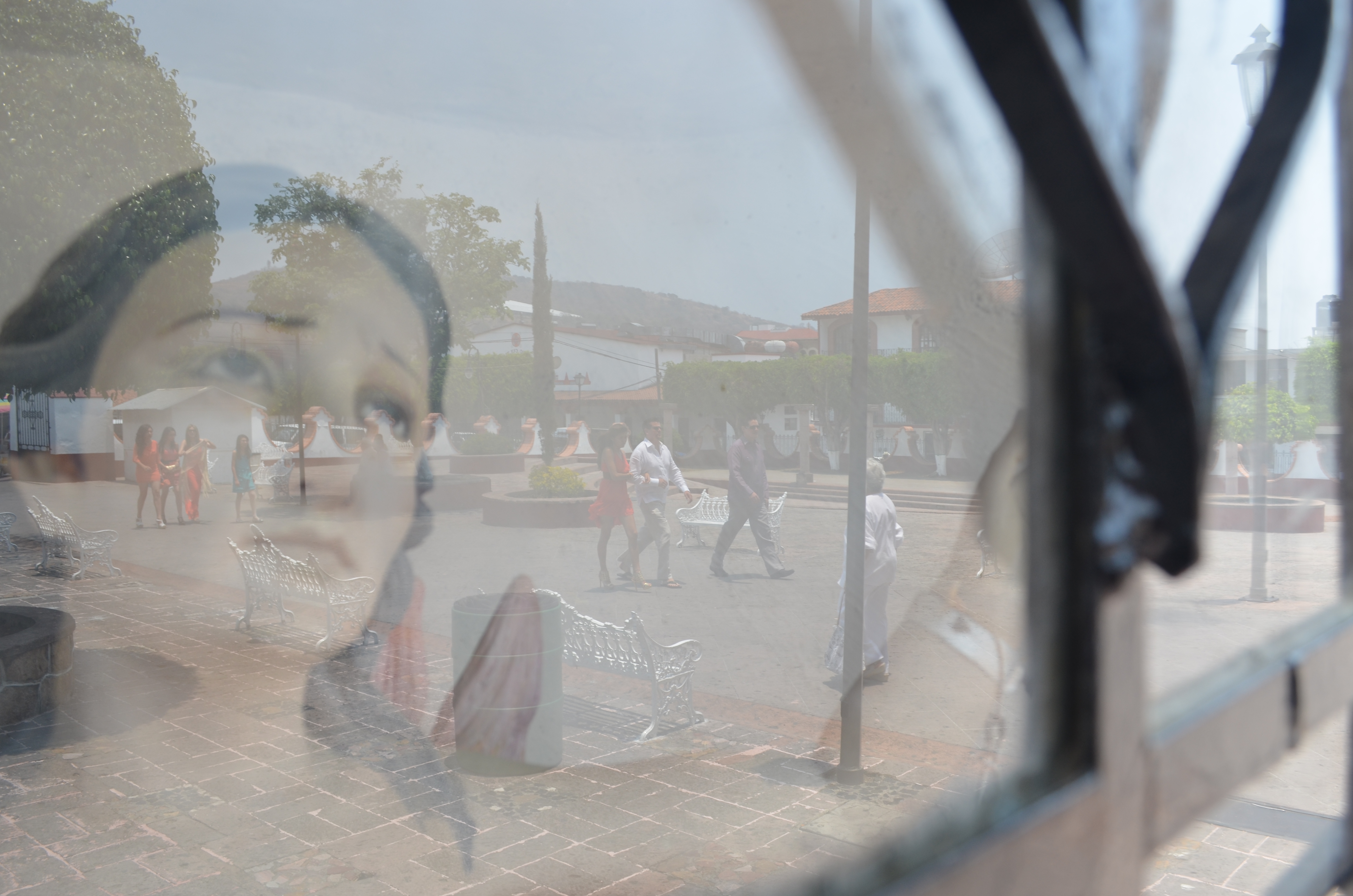
Town square, Tonatico, Estado de Mexico. [RF]

FUJIMORI TODAY

FILES-PERU-FUJIMORI-JUSTICE

Late last week, the current Peruvian president, Ollanta Humala, turned down the pardon plea of  former Peruvian President Alberto Fujimori, currently serving a 25-year prison term for corruption and crimes against humanity. The LA Times’ Chris Kraul and Adriana Leon remind us:

Fujimori, 74, was convicted in 2009 of ordering massacres against left-wing dissidents in 1991 and 1992 that left 25 people dead. He was also convicted of ordering the kidnapping of investigative journalist Gustavo Gorriti.

Above is a photo of Fujimori  (Handout / AFP/Getty Images, via LA Times), that shows him on a prison cot. He says he suffers from tongue cancer. Humala wasn’t moved.

The Fujimori story is a classic Latin American tragedy. After taking office in 1990, he took the fight to the bloodthirsty Shining Path guerrilla group, and steadied a basket-case economy suffering from Weimar-level inflation rates.

But Peruvian society would eventually decide that Fujimori should be punished for his overreach — for the extrajudicial disappearances, the quiet killings, the nightmare strategy that he used to beat back a nightmare.

So there he lies.


LO LEGAL

El Bebeto’s “Lo Legal” (“What’s Legal”) is a monster hit on Mexican radio. It’s technically a love song, with no direct reference to  U.S. immigration policy, the wave of immigration that saw millions of Mexicans head north in recent years, or the separation and heartbreak that resulted.

But if you want it to be a protest song, it’s all there. (The video, above, connects the dots a little more explicitly.)

CANTA Y NO LLORES

LAO__Garcetti&Alonso-thumb-600x431-20491

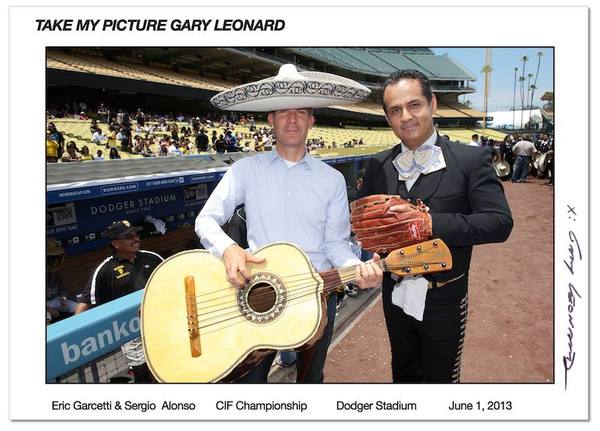
Gary Leonard catches Los Angeles’ latest Spanish-speaking, Mexican-roots-having mayor at Dodger Stadium with a guitarron. Follow Leonard’s “Take My Picture” feature here.


EL PENDULO

calendario20Anios

The El Pendulo bookstore chain is one of the great pleasures of living in Mexico City. As the neighborhood bookstore vanishes north of the border, the American reader can’t help but wonder how El Pendulo has managed to stay successful in a rapidly changing publishing world. Some of it has to do with diversifying beyond just books: like Barnes & Noble, El Pendulo will sell you a wacky novelty gift if that’s what you’re looking for (they also run restaurant-cafes at most branches, and have a little concert venue in La Roma). But their success also seems to have something to do with capturing the spirit of the city of Fuentes, of Paz, the city where Bolaño traipsed around with his ne’er-do-well friends, poor, righteous, and itching for a literary spat.

And yet, in the U.S., so many bookstores that captured the spirit of their own literary communities are long gone.

On June 9th, the Condesa Pendulo will be celebrating the chain’s 20th anniversary with a “Liberacion colectiva de libros.” Chilango magazine says that means that they’ll be letting 1,000 books loose in the wild somehow, each with a stamp that reads, “This is a free book. Read it and return it to another public place.”

DISAPPEARED

Mexico City mystery


Originally posted at www.latimes.com:

A kidnapping mystery in Mexico City

The disappearance of 11 young people, purportedly from a Zona Rosa bar, causes concern about whether the capital can remain relatively immune from violence gripping other parts of the country.

By Richard Fausset, Los Angeles Times
May 31, 2013, 5:13 p.m.

MEXICO CITY — The Mexican capital has managed to avoid the kind of gangland violence that has gripped many other parts of the country in recent years. But the mysterious disappearance of 11 young people from a bar this week is raising new fear about the city’s ability to remain relatively immune from the trouble.

The disappearance of the patrons in the Zona Rosa, a nightclub-packed neighborhood just blocks from the U.S. Embassy, has made national headlines and dominated TV news here.

As of Friday, however, it was not clear what happened to them. Were the missing really whisked away by armed, masked men in SUVs?

That is the version of events promulgated by parents and other family members who blocked streets and gathered inMexico City’s central square this week to raise awareness of their loved ones’ plight. But city officials so far say they have been unable to corroborate the story.

If true, it would prove to be a rare occurrence in the capital of what Mexicans call a levanton, a mass kidnapping, often perpetrated by criminals pretending to be police, that is all too common in those Mexican states overrun by drug cartel violence.

It would also be another high-profile blow to Mexico City’s reputation as a relatively safe haven: On May 9, Malcolm X‘s grandson, Malcolm Shabazz, was slain in a nightclub near Plaza Garibaldi, the mariachi gathering spot popular with tourists.

Prosecutors say the missing are four young women, six young men and a 16-year-old boy. Family members say that the 11 were partying in the bar about 10 a.m. Sunday, when they were encouraged to step outside by the bar’s workers, who told them that the police had arrived.

From there, the families believe, the young people were stuffed into SUVs by masked men.

The family members apparently learned this version of events from a patron who escaped to the roof and claims to have seen the armed men abducting the victims. Edmundo Garrido, a Mexico City deputy prosecutor, said in a radio interview Friday that investigators had a “preliminary contact” with the witness but were now searching for him.

“We have the name, we’re looking, we haven’t found him at his house,” Garrido said.

Both local and federal officials insisted that no police action was planned for the area at the time of the reported disappearance.

As a decade ago, the Zona Rosa was one of the city’s preeminent neighborhoods. It has slipped recently, acquiring a reputation for late-night drug deals, but is not considered one of the city’s roughest areas.

Most of the victims, however, hail from Tepito, a neighborhood notorious for harboring illicit drug and piracy rings. The newspaper El Universal reported Friday that the fathers of two of the missing youths are serving sentences for running a Tepito extortion and drug-dealing gang. An official with the prosecutor’s office would not confirm or deny the report when contacted Friday by The Times.

Jesus Rodriguez Almeida, head of the city’s public security ministry, told reporters Thursday that officials hadn’t been aware of the disappearance until midweek, when the family members blocked a road in protest.

Mexico City Mayor Miguel Angel Mancera said in a news conference Thursday that neither the manner nor the location of the disappearance had been corroborated by evidence officials had gathered thus far.

Investigators raided the bar Thursday night. Garrido said they recovered six cameras and were reviewing video from these and other security cameras outside.

Prosecutors have met at least twice with family members but had little news to share with them.

“Nothing is known,” Julieta Gonzalez, the mother of one of the missing youths, said in a television interview after one such meeting Thursday. “They told us that it wasn’t the police.”

richard.fausset@latimes.com

Karla Tenorio Zumarraga in The Times’ Mexico City bureau contributed to this report.
Copyright © 2013, Los Angeles Times

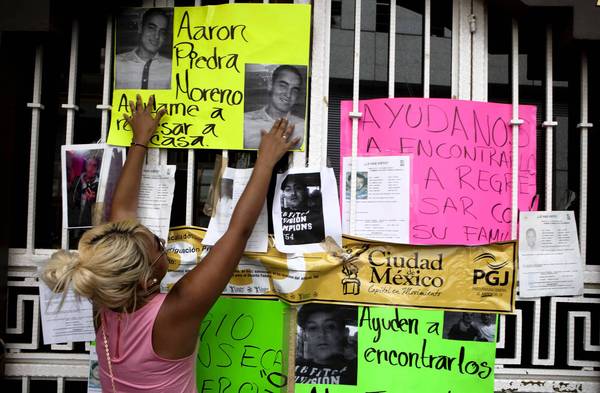
Photo: Pictures of some of the missing youths are posted in the entrance of the Zona Rosa bar from which they purportedly disappeard. (Eduardo Verdugo, AP / May 30, 2013, via Los Angeles Times)


PRO-POT FOX

Here is former Mexican President Vicente Fox, of the conservative National Action Party, calling for the legalization of marijuana on CNN this week.

The conversation about legalization has intensified in Mexico since voters legalized pot in Colorado and Washington state. But polls show that the Mexican people aren’t yet falling in line with Fox and the Mexican chattering classes.