mexico

LO LEGAL

El Bebeto’s “Lo Legal” (“What’s Legal”) is a monster hit on Mexican radio. It’s technically a love song, with no direct reference to  U.S. immigration policy, the wave of immigration that saw millions of Mexicans head north in recent years, or the separation and heartbreak that resulted.

But if you want it to be a protest song, it’s all there. (The video, above, connects the dots a little more explicitly.)

EL PENDULO

calendario20Anios

The El Pendulo bookstore chain is one of the great pleasures of living in Mexico City. As the neighborhood bookstore vanishes north of the border, the American reader can’t help but wonder how El Pendulo has managed to stay successful in a rapidly changing publishing world. Some of it has to do with diversifying beyond just books: like Barnes & Noble, El Pendulo will sell you a wacky novelty gift if that’s what you’re looking for (they also run restaurant-cafes at most branches, and have a little concert venue in La Roma). But their success also seems to have something to do with capturing the spirit of the city of Fuentes, of Paz, the city where Bolaño traipsed around with his ne’er-do-well friends, poor, righteous, and itching for a literary spat.

And yet, in the U.S., so many bookstores that captured the spirit of their own literary communities are long gone.

On June 9th, the Condesa Pendulo will be celebrating the chain’s 20th anniversary with a “Liberacion colectiva de libros.” Chilango magazine says that means that they’ll be letting 1,000 books loose in the wild somehow, each with a stamp that reads, “This is a free book. Read it and return it to another public place.”

DISAPPEARED

Mexico City mystery


Originally posted at www.latimes.com:

A kidnapping mystery in Mexico City

The disappearance of 11 young people, purportedly from a Zona Rosa bar, causes concern about whether the capital can remain relatively immune from violence gripping other parts of the country.

By Richard Fausset, Los Angeles Times
May 31, 2013, 5:13 p.m.

MEXICO CITY — The Mexican capital has managed to avoid the kind of gangland violence that has gripped many other parts of the country in recent years. But the mysterious disappearance of 11 young people from a bar this week is raising new fear about the city’s ability to remain relatively immune from the trouble.

The disappearance of the patrons in the Zona Rosa, a nightclub-packed neighborhood just blocks from the U.S. Embassy, has made national headlines and dominated TV news here.

As of Friday, however, it was not clear what happened to them. Were the missing really whisked away by armed, masked men in SUVs?

That is the version of events promulgated by parents and other family members who blocked streets and gathered inMexico City’s central square this week to raise awareness of their loved ones’ plight. But city officials so far say they have been unable to corroborate the story.

If true, it would prove to be a rare occurrence in the capital of what Mexicans call a levanton, a mass kidnapping, often perpetrated by criminals pretending to be police, that is all too common in those Mexican states overrun by drug cartel violence.

It would also be another high-profile blow to Mexico City’s reputation as a relatively safe haven: On May 9, Malcolm X‘s grandson, Malcolm Shabazz, was slain in a nightclub near Plaza Garibaldi, the mariachi gathering spot popular with tourists.

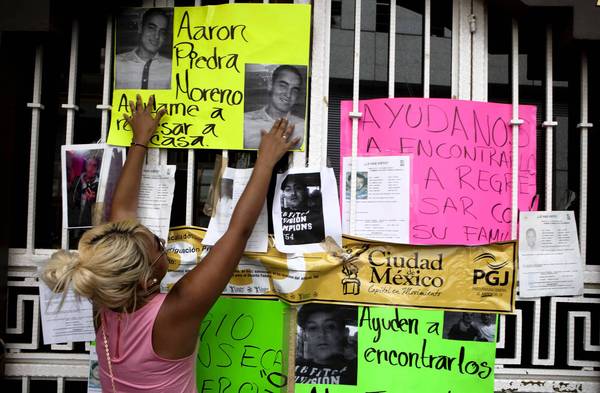
Prosecutors say the missing are four young women, six young men and a 16-year-old boy. Family members say that the 11 were partying in the bar about 10 a.m. Sunday, when they were encouraged to step outside by the bar’s workers, who told them that the police had arrived.

From there, the families believe, the young people were stuffed into SUVs by masked men.

The family members apparently learned this version of events from a patron who escaped to the roof and claims to have seen the armed men abducting the victims. Edmundo Garrido, a Mexico City deputy prosecutor, said in a radio interview Friday that investigators had a “preliminary contact” with the witness but were now searching for him.

“We have the name, we’re looking, we haven’t found him at his house,” Garrido said.

Both local and federal officials insisted that no police action was planned for the area at the time of the reported disappearance.

As a decade ago, the Zona Rosa was one of the city’s preeminent neighborhoods. It has slipped recently, acquiring a reputation for late-night drug deals, but is not considered one of the city’s roughest areas.

Most of the victims, however, hail from Tepito, a neighborhood notorious for harboring illicit drug and piracy rings. The newspaper El Universal reported Friday that the fathers of two of the missing youths are serving sentences for running a Tepito extortion and drug-dealing gang. An official with the prosecutor’s office would not confirm or deny the report when contacted Friday by The Times.

Jesus Rodriguez Almeida, head of the city’s public security ministry, told reporters Thursday that officials hadn’t been aware of the disappearance until midweek, when the family members blocked a road in protest.

Mexico City Mayor Miguel Angel Mancera said in a news conference Thursday that neither the manner nor the location of the disappearance had been corroborated by evidence officials had gathered thus far.

Investigators raided the bar Thursday night. Garrido said they recovered six cameras and were reviewing video from these and other security cameras outside.

Prosecutors have met at least twice with family members but had little news to share with them.

“Nothing is known,” Julieta Gonzalez, the mother of one of the missing youths, said in a television interview after one such meeting Thursday. “They told us that it wasn’t the police.”

richard.fausset@latimes.com

Karla Tenorio Zumarraga in The Times’ Mexico City bureau contributed to this report.

Copyright © 2013, Los Angeles Times

Photo: Pictures of some of the missing youths are posted in the entrance of the Zona Rosa bar from which they purportedly disappeard. (Eduardo Verdugo, AP / May 30, 2013, via Los Angeles Times)


PRO-POT FOX

Here is former Mexican President Vicente Fox, of the conservative National Action Party, calling for the legalization of marijuana on CNN this week.

The conversation about legalization has intensified in Mexico since voters legalized pot in Colorado and Washington state. But polls show that the Mexican people aren’t yet falling in line with Fox and the Mexican chattering classes.

HOLLYWOOD AZTECS

1421252_ME_0501_aztecs_for_hire_2_01_DPB


In Mexico City, drum-pounding, shell-shaking Aztec dance troupes have long been a fixture in the zocalo, or central square. Stray dancers even turn up at traffic lights in neighborhoods further afield, performing for tips.

In today’s LA Times, my colleague Hector Becerra reports that Aztec dance troupes have also become a fixture at left-wing political rallies in Southern California. Hector has a little bit of fun dancing around the fact that Aztec culture wasn’t exactly a 21st Century liberal’s paradise. Don Bartletti and Christina House have fun with the photos.

Photo: No one ignores the dancing Aztecs. Crowds press close, pulling out iPhones and cameras. (Don Bartletti / Los Angeles Times / May 1, 2013. Via http://www.latimes.com. )

HELI

Last weekend, a 34-year-old from Guanajuato, Mexico named Amat Escalante won the Best Director prize at Cannes for his movie “Heli,” which Kenneth Turan, the Los Angeles Times’ film critic, described as “a grim look at a society overwhelmed by extreme drug war-related violence.”

It’s the graphic violence in the film that has received the most attention. Escalante has defended his depictions of violence, and has even had to tell the world that he’s not trying to do harm to the Mexican tourist industry (apparently,  a U.S. journalist canceled vacation plans after a screening).

Until its release in the US and Mexico, we have the trailer for “Heli,” to go on. It’s simple, enigmatic, and  violence-free. What it captures is the threat of violence, which is oftentimes more terrifying than the act itself.

In it, a young man, for reasons we don’t know, wordlessly confronts one of the thousands of armed, masked warriors who are a fixture on the landscape of modern Mexico.

Some of the masked men are good guys. Some are bad. Oftentimes, you just don’t know.

BLAM

DSC_0384


Market stall, Mexico City. [RF]

CABEZAZO

The most dramatic moment of last night’s Mexican soccer championship came when Moises Muñoz, the goalkeeper for the eventual winners, Club America, traveled the length of the field, entered the scrum during a corner kick, and butted in the header, or cabezazo, that put America ahead 2-1 with just moments left in the game. Because each team had scored two goals over the course of two games, there was a period of bonus play (in which neither team scored), and, then, a penalty-kick showdown, which America won in the middle of a pounding rainstorm.

A goalie scoring a goal in soccer is pretty rare; Wikipedia keeps a running list of those goalies known to have done so, including the Brazilian goalie Saulo, who, like Muñoz, headed a corner kick back in 2011.

“While celebrating the goal,” the Wikipedia authors note, drily, Saulo “suffered a concussion which would prevent him from playing for a period.”

So, yeah, it’s a big deal.

MARTIN DE LA TORRE: BORED BLUE LINE

DLT cops

Photo: Police in the Mexican capital, waiting for something to happen. By Mexico City-based photographer Martin de la Torre. See more of de la Torre’s work here and here.