THE STATE OF THINGS

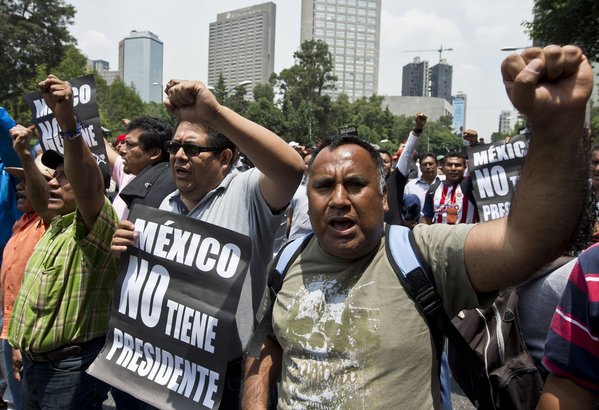
Protest against the education overhaul in Mexico


Originally posted at www.latimes.com:

Peña Nieto’s first state of union comes amid uncertainty in Mexico

Nine months after Mexico President Enrique Peña Nieto assumed office, his well-choreographed reform plans have met some unexpected obstacles.


By Tracy Wilkinson and Richard Fausset
September 1, 2013, 11:00 a.m.

MEXICO CITY — When President Enrique Peña Nieto delivers his first state of the union message on Monday, he won’t leave home to do it.

The unusual venue — his residence, Los Pinos — is replacing the more traditional spot, the presidential National Palace, because striking teachers  have laid siege to the plaza surrounding it. Government officials and invited dignitaries would have a tough time reaching the palace.

Nine months into Peña Nieto’s presidency, not everything is going quite according to his well-choreographed, carefully hyped plans.

Leading the Institutional Revolutionary Party that had ruled autocratically for seven decades until getting the boot in 2000, the telegenic politician came to power in December by promising a new Mexico, one that would take its rightful place on the world stage, impressing audiences here and abroad with an ambitious project of “transformational” economic changes.

In addition, he was emphatic about minimizing the issue that had dominated global discussion of Mexico in the previous years: the government’s deadly battle with drug traffickers and the criminal networks they have spawned.

Instead, the economy has stalled, shrinking this quarter for the first time in four years, and violent drug-and-extortion gangs have so overwhelmed citizens in some states that they have taken up arms to protect themselves. The government, they say, won’t.

Meanwhile, Peña Nieto’s reform agenda is hitting unexpected speed bumps with disruptive protests in recent days.

Teachers enraged over Peña Nieto’s plan to overhaul the educational system have managed, day after day, to shut down Congress, block major streets, besiege embassies and government buildings here in the capital, ground people trying to reach the main international airport, and force the cancellation of cherished soccer matches.

In a rush to build momentum, Peña Nieto succeeded in getting legislative approval and even constitutional changes to pass major education and telecommunications laws. Two more, dealing with energy and fiscal policy, are on deck.

The teachers’ street fight, however, shows that stiff and disruptive opposition could still derail his plans.

“The reality has impinged on him at last,” said Federico Estevez, a professor of political science at the Autonomous Technological Institute of Mexico. “It’s not easy to ward off the pessimism that will be spreading really quickly in the next few weeks and months.”

The demonstrations by thousands of members of a dissident teachers union are in protest of a requirement that teachers be evaluated, hired and promoted based on merit. While tying up the capital, the demonstrators have succeeded in persuading the lower chamber of Congress to delay, at least temporarily, the enabling legislation that would allow the changes to kick in.

An even larger danger for Peña Nieto is that the teachers’ actions could inspire similar chaos when his proposal to open oil and gas exploration to private and foreign investment comes up for a vote.

“What’s at stake is not just [one] reform,” said Claudio X. Gonzalez, head of Mexicanos Primero, an education advocacy group, “but the administration of President Peña Nieto and his entire reform agenda.”

The political left is already voicing impassioned opposition to the energy plan and has called for a massive rally Sept. 8. Opponents see the plan as a thinly veiled move to privatize Mexico’s lucrative oil industry, with the benefits going to an elite few.

In his speech, which had been set for Sunday but was moved back a day, Peña Nieto is expected to reiterate claims of several important accomplishments in this initial season of his six-year term. He takes credit for what he calculates to be a 20% decline in homicides in the first six months of his government, compared with the same period the previous year.

He has not provided statistics to back the claim, though the number of homicides did begin to decline well before he took office. Moreover, his government’s policy has been to order its spokespeople to release only minimal details about killings and arrests. And some experts question the government’s methodology in counting the dead.

Throughout his campaign and the first months of his presidency, Peña Nieto pledged a “different” security strategy that would reduce crime without the army-heavy focus on dismantling drug organizations. But he has failed thus far to articulate the details of a different approach.

His most visible actions are reminiscent of the controversial tactics of his predecessor, PresidentFelipe Calderon. After initially criticizing the so-called kingpin strategy of focusing on the detention or death of drug cartel bosses, Peña Nieto’s government in recent weeks has rolled up two major drug gang chiefs. And the administration’s first major military operation involved sending troops into the inflamed state of Michoacan, replicating Calderon’s first major military operation in December 2006.

The centerpiece of Peña Nieto’s security strategy has been the creation of a gendarmerie, a special police force that would replace the controversial military deployment. But last week, the government revealed a vastly reduced and delayed gendarmerie that will be a fraction of its originally planned size, is running a year behind schedule in its formation and is being relegated to a subdivision within the federal police.

Even some of Peña Nieto’s most important achievements have begun to lose their luster. His government was cheered when it ordered the arrest of notorious teachers union boss Elba Esther Gordillo, whose lavish lifestyle and other excesses finally resulted in charges of embezzlement and involvement in organized crime.

But some Mexicans now wonder whether Gordillo was being punished because she had refused to support Peña Nieto, while another union leader of equally ill repute, the steadfastly loyal Carlos Romero Deschamps, remains a government favorite.

Peña Nieto’s Pact for Mexico, a consensus-building arrangement of the major political parties, was hailed as a breakthrough in good governance. It’s possible that the consensus, despite numerous threats of coming apart, will hold together in the long run, and that the president, who is constitutionally barred from seeking reelection, will be able to ride out the street protests and see much of his reform agenda enacted. For the time being, though, the voices of discontent are rising.

“What’s left of the Mexican moment?” Alberto Aziz Nassif, a political expert at Mexico City’s Center for Research and Higher Education in Social Anthropology, wrote in the newspaper El Universal. “An expectation, full of smoke, that disappeared in the face of a lack of growth. The poverty that remains, the violence that hasn’t diminished, the inertia of regression, … the reforms that, at the moment, are blocked.”

In an interview, Aziz said the imminent timing of even a seemingly wonky piece of legislation like fiscal overhaul will potentially add to popular unrest because it includes taxes on food and medicine that the left and poor oppose.

“You can see a complicated situation,” Aziz said. The government probably has the votes to pass its proposals in Congress, but would have to deal with a growing opposition movement. That could force the administration to choose only the most “urgent and necessary” reforms, Aziz said, and postpone the rest.

Peña Nieto’s government received laudatory if premature praise for what was often portrayed as a booming economy. But in recent weeks, growth projections for 2013 have been slashed to as low as 1.2%. Even Peña Nieto’s right-hand man, Finance Minister Luis Videgaray, was forced to label the country’s economic performance “mediocre.”

Analysts blame the poor rate of U.S. importation of Mexican goods, which hurt production here, and slow, hesitant spending by the government. But they are not writing off the slightly more distant future.

“Growth figures for 2013 have been disappointing; expectations were high,” said Alonso Cervera, a Mexico-based research analyst for Credit Suisse. “Medium-term growth, however, remains quite promising — if the reforms go through.”

As Cervera spoke, he looked down from his 27th-floor office window at Mexico City’s most important thoroughfare, Reforma Boulevard, where it intersects with the main north-south freeway.

It was completely shut down in the middle of a weekday, lined by police guarding against striking teachers.
Copyright © 2013, Los Angeles Times

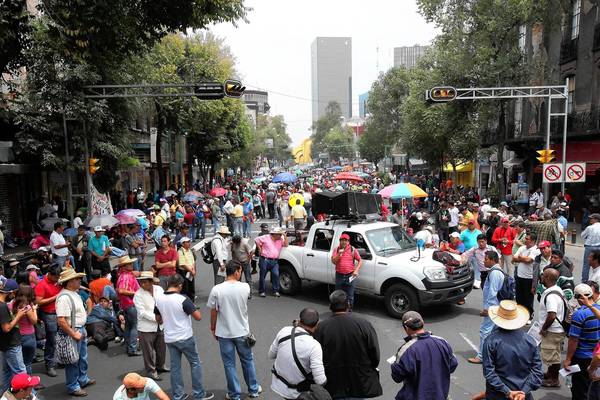
Photo: Members of a teachers union block a street Friday outside a government building in Mexico City. In another part of the city, thousands of the striking teachers have laid siege to the plaza surrounding the presidential National Palace. (Alex Cruz / European Pressphoto Agency / August 30, 2013, via LA Times)

TEACHERS

TOPSHOTS-MEXICO-EDUCATION-TEACHERS-PROTEST


Originally posted at www.latimes.com:

Teacher strike in Mexico City drawing ire

By Richard Fausset
August 30, 2013, 3:35 p.m.

MEXICO CITY — The thousands of teachers who have been jamming the streets in this congested capital city for nearly two weeks to protest an education reform package have no immediate plans to leave, and the threat of their continued presence is prompting calls for the government to forcibly move them out.

The teachers, members of the National Coordinator of Education Workers, or CNTE, have been marching daily and blocking major thoroughfares, trying the patience and denting the pocketbooks of residents like Carlos Fabian Manterola, a 41-year-old taxi driver.

If Mexico City’s mayor, Miguel Angel Mancera, were to kick the teachers out, Fabian said Friday, “a lot of us would applaud him…. The government leaders, they don’t care. They fly around in helicopters. We’re the ones who suffer.”

The government of President Enrique Peña Nieto is hoping to push through the last major element of an education reform in Congress that would subject teachers to evaluations. The teachers oppose this measure and argue, among other things, that the government should spend more generously on underperforming schools.

Many of the protesters remain camped out in a huge tent city in the Zocalo, the city’s historic main square. That has prompted Peña Nieto to move his state of the union speech, now scheduled for Monday, from the Zocalo’s National Palace to Los Pinos, the presidential residence, a few miles away.

Each day, the protesters have chosen to deploy in different parts of the city, including at government buildings, on a major highway, and on the road to the airport. The uncertainty has disrupted plans small and large. Flights have been missed, school bus schedules have been delayed, and a major pro soccer game set for this weekend has been postponed.

Moreover, it seems increasingly possible that the teachers could stick around for Sept. 15, when the president traditionally issues the “Cry of Dolores” (Miguel Hidalgo’s 1810 call to arms) in a festive event commemorating Mexican independence that usually sees the Zocalo packed with tens of thousands of revelers.

The teachers could help the Mexican left gain momentum in its opposition to Peña Nieto’s broader reform package, which includes a proposal to open the state oil company to foreign investment. Leftist leader Andres Manuel Lopez Obrador has called for a Sept. 8 street demonstration opposing that plan.

So far, at least, the protesters are struggling to win the locals’ hearts and minds. In a telephone poll of Mexico City residents Wednesday, the newspaper Reforma found that 59% of respondents favored the use of force against the teachers. The city’s human rights commission has declared it is not opposed to the “legitimate” use of force to clear the streets. And the chamber of commerce claims that the union has caused more than $32 million in losses for local businesses.

Though the government has not indicated how it plans to proceed, some on the left are already warning darkly of a crackdown. Leftist Congressman Ricardo Monreal said in a radio interview Friday that he had “firsthand” information that the government would be using high-pressure water cannons to clear the Zocalo this weekend.

Such fears carry serious historical weight in Mexico, where a deadly 1968 crackdown on student protesters continues to resonate as an object lesson on government’s potential to trample human rights.

After declaring that he approved of a forceful government crackdown against the teachers, Fabian, the cab driver, added an important qualifier:

Just so long as no one gets beaten, he said.

Copyright © 2013, Los Angeles Times

Photo: Teachers protest and block highways to protest e education reform legislation, in Mexico City on Wednesday. (Ronaldo Schemidt / AFP/Getty Images / August 28, 2013, via LA Times)

OINK

pig


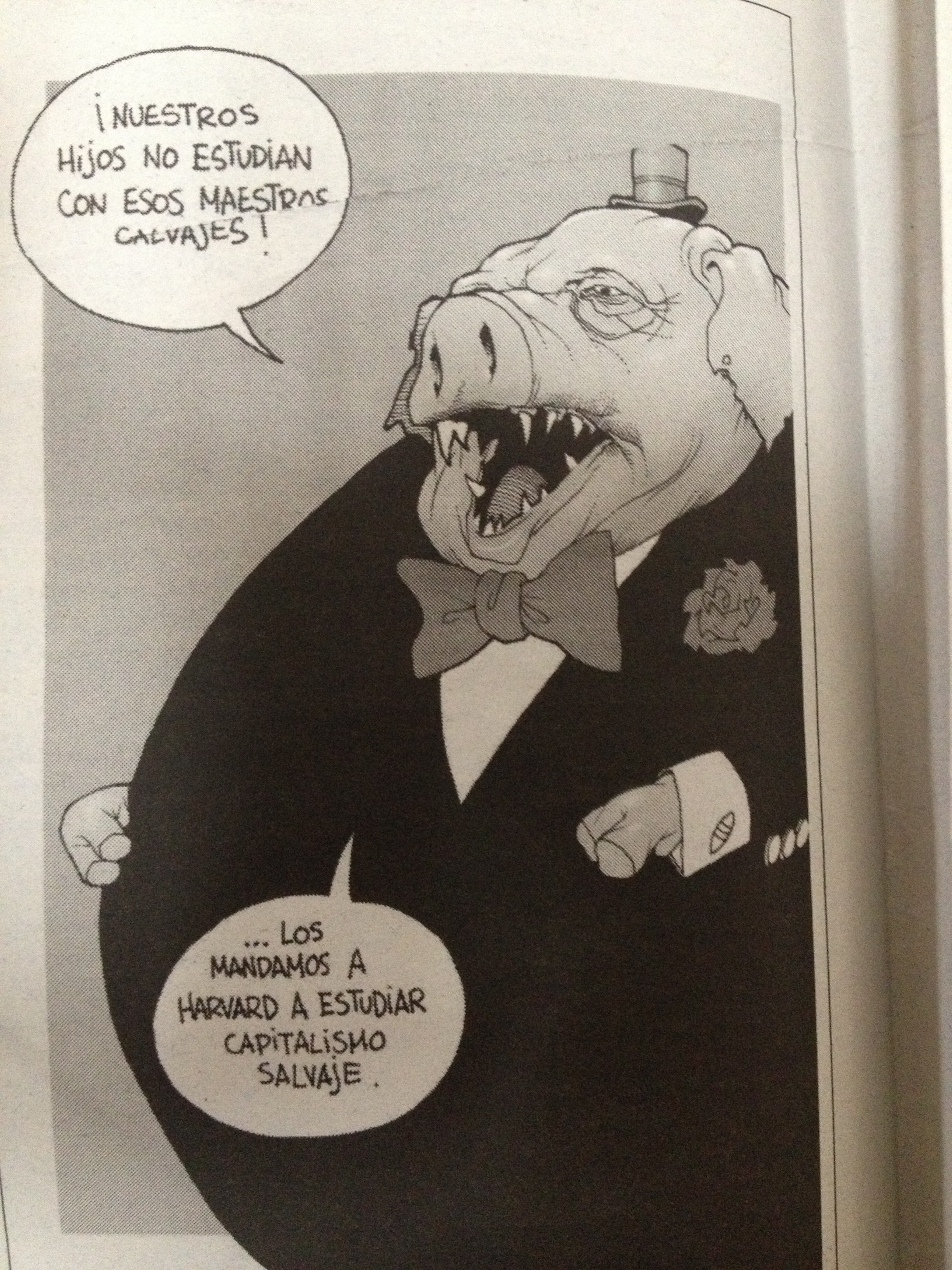
You’ve got to hand it to the Mexican left: they excel at the lost art (lost in the States, at least) of portraying capitalists as rapacious, predatory, slobbering oligarchs. In the US, we’ve grown pretty accustomed, in the Silicon Valley era, to thinking of our most dynamic capitalists as snot-nosed young geniuses in hoodies. To the cartoonist brigade of the Mexican left, the moneyed class will forever be populated by portly gents in evening wear and top hats, flashing their robber-baron watch fobs and their searing contempt for the proletariat.

The cartoon above, from the August 21 issue of La Jornada, is referring to the negative reaction to the teachers’ union protests in Mexico City that have snarled traffic and caused the delay of soccer games and the president’s first state of the union address.

“Our kids don’t study with those savage teachers,” says the pig. “We send them to Harvard to study savage capitalism.”

JOVENES

kids


Kids at a festival for indigenous cultures, Guadalajara, Jalisco. [RF]

ENFOCADO

06-Munal


I’m looking forward to seeing the exhibit “México a través de la fotografía,” which just opened at the National Art Museum here in Mexico City, and runs through November.

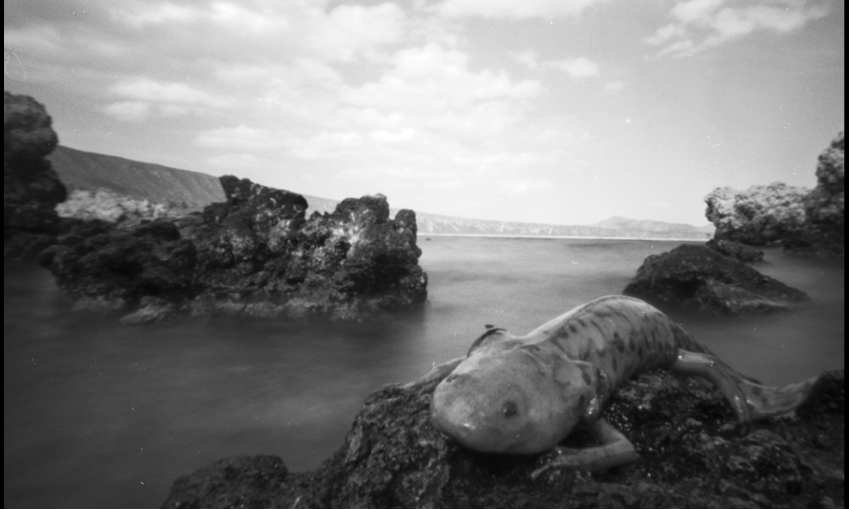
Above: “El Axolote Gigante del Lago de Alchichica”, Puebla, 2001; by Daniel Mendoza Alafita. You can read my story on the plight of the axolote, the effort to save it, and its role in Mexican culture and the fragile ecology of the valley of Mexico, here.

[Photo: munal.mx, via aristeguinoticias.com]

MONUMENT

DSC_0396 DSC_0401 DSC_0410


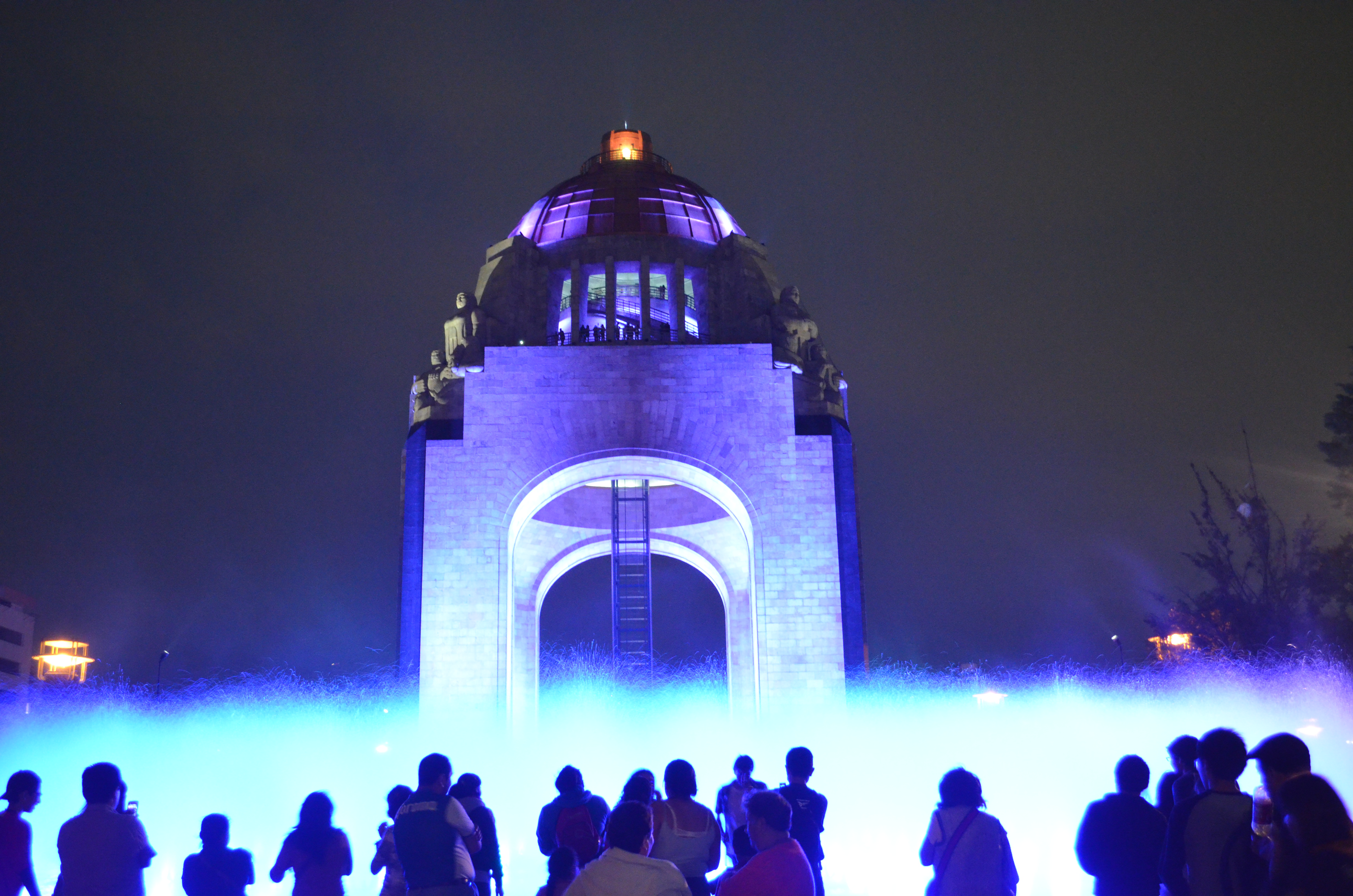
Nighttime at Mexico City’s Monument to the Revolution. [RF]

NOWHERE, EVERYWHERE

Originally posted at www.latimes.com:

MEXICO UNDER SIEGE

Freed drug lord missing, but present in Guadalajara

Rafael Caro Quintero, wanted by the U.S., has been ordered rearrested in Mexico. Whether or not he is hiding out in Guadalajara, his business interests are prominent here.

By Richard Fausset
August 25, 2013, 7:00 a.m.

GUADALAJARA, Mexico — There are some who suspect that Rafael Caro Quintero has hidden himself away here in this pleasant provincial capital where he was once known as “The Prince” — the drug lord with the gold-plated pistols who, back in the 1980s, doled out new Ford sedans as a way to win friends and influence people.

Others think he may have vanished into the rural badlands of Sinaloa, where he was born and raised.

Then there are those who wonder whether it is even safe to speculate on the whereabouts of a convicted murderer who was sprung from prison this month on a technicality, yet whose legend and business network remain formidable, despite nearly three decades behind bars.

“His location? I can’t imagine. Nor do I want to imagine,” said Jose Luis Guizar, his former defense attorney, with a mordant chuckle. “That may be a mortal sin.”

Today, Mexican authorities are presumably on the hunt for Caro Quintero, who walked out of Guadalajara’s Puente Grande penitentiary on Aug. 9 after an appeals tribunal controversially declared that he had been tried in the wrong court for the slaying of four people, including U.S. drug enforcement agent Enrique “Kiki” Camarena, in 1985. (The tribunal ruled that he should not have been tried in federal court because it did not consider Camarena a member of the diplomatic corps.)

Officials in Washington, livid that he did not serve his full 40-year sentence, have formally requested his extradition to the United States, where he is wanted on suspicion of a number of felonies, including murder. A Mexican judge has since ordered his rearrest.

Whether the Mexican government is capable of finding Caro Quintero remains to be seen. And yet his presence, manifested in his lingering legacy and fortune, is inescapable in Guadalajara, the leafy capital of the western state of Jalisco that he once called home.

In addition to being a founder of the Guadalajara drug cartel, Caro Quintero was said to be a partner, in the 1980s, in 300 businesses, including a luxury hotel, nightclubs, restaurants and a Ford dealership. Despite his rough-hewn rural background and first-grade education, he found allies in Guadalajara’s more traditional business class.

In some ways it was a good fit. Metropolitan Guadalajara, with its population of 4.4 million, is perhaps best known as the home of traditional Mexican culture, of mariachi and tequila. But it is also a city with thriving manufacturing and tech industries, and is proud of its modern, pro-business climate: A sign over the highway into town reads, “Welcome to Entrepreneurs Land.”

And Caro Quintero was nothing if not an entrepreneur.

His style was far from subtle. He had a fondness for adorning his weapons with diamonds. He famously wooed the niece of an ex-governor of Jalisco state by showering her with new cars and jewels. Police were allegedly bought with cash and Crown Victoria sedans. One witness in a criminal case memorably recalled seeing him at a party, smoking cocaine on the back of a prancing horse.

In a jailhouse interview years after his arrest, he claimed to have lost everything, including numerous ranches and 5,000 head of cattle.

But U.S. officials paint a different picture. For years, they have monitored what they describe as a complicated web of businesses that have helped launder his dirty money. And they say Caro Quintero has maintained an alliance with a branch of the Sinaloa cartel, currently Mexico’s most powerful criminal enterprise.

In June, the U.S. Treasury Department designated 15 businesses and 18 people in and around Guadalajara — including Caro Quintero’s four children, wife and brother-in-law — as being active players in his commercial network. As a result, they were placed on the U.S. government’s “kingpin” list, which prohibits Americans from conducting business with them and freezes any U.S. assets they may have.

But such restrictions accomplish only so much. Last week in an American-style indoor shopping mall called the Plaza Patria, a cheerful kiosk, part of the local bath and body chain called El Baño de Maria, offered pampering foot-scrub kits and spearmint-tea soap bars to a clientele that was unaware or didn’t care that the chain had been designated a money-laundering operation for the capo. (A branch of the store had been operating in a terminal of the Guadalajara airport until just a few weeks ago, according to airport employees.)

It was the same at the blacklisted Barbaresco restaurant, a chic, airy place where patrons dined on gourmet pizzas and salmon salads under splashy modern-art canvases.

On a busy road south of town, there was no sign that anything was amiss at a luxury gated community called Provenza Residencial, only banners promising future homeowners “tranquillity,” “exclusivity” and “fun.”

According to the Treasury Department, Provenza is owned or controlled by Juan Jose Esparragoza Morena, identified as a longtime drug trafficking partner of Caro Quintero and a current Sinaloa cartel boss. The Treasury Department alleges that Caro Quintero is an investor in the venture.

Predictably, none of this came up in a tour of the property. Instead, a salesman talked up the pool and gym, the basketball and tennis courts, the clean air and the 30-minute commute into town. New homes start at about $250,000, and the company, the agent said, was happy to help with financing.

The other Caro Quintero-affiliated businesses on the Treasury Department list are similarly unremarkable, the kind that pump wealth into any big city economy: a chain of shoe stores, a luxury spa, a gas station company, real estate and construction firms, a swimming pool business.

The suspicion that ill-gotten gains may be behind everyday businesses is a common one in Mexico, and particularly prevalent in Guadalajara since the mid-1970s, when Caro Quintero and his associates, feeling pressure from government crackdowns in their home state of Sinaloa, moved to town and established the city as their headquarters.

The custom continues to this day, and it is not likely to fade anytime soon. Guadalajara has long been surrounded by some of the country’s most important marijuana and poppy-growing regions, and its strategic importance has increased with the rise of the methamphetamine trade. Precursor chemicals from Asia are shipped to the Pacific port of Manzanillo, and meth labs now dot the landscape between the port and Jaliscan capital.

A new generation of capos, following the precedent set by Caro Quintero, are assumed to be living behind the walls of the city’s suburban enclaves, sending their kids to the better schools, and plowing their drug proceeds into numerous non-drug enterprises.

Residents have inured themselves to the possibility that any business might be connected. After suspected drug trafficker (and purported Caro Quintero relative) Sandra Avila Beltran, known as the “Queen of the Pacific,” was arrested in 2007, authorities seized 200 of her businesses, including a chain of Jalisco tanning salons called Electric Beach. Though acquitted of drug-trafficking charges, she is currently facing money-laundering charges in a Mexican court.

“Those are the suspicions you live with,” said a woman visiting a strip mall next to the Provenza development, who, like many here, declined to give her name for fear of getting mixed up with the capos. “You never know who the owners are.”

Though he might prove difficult to find, Caro Quintero is unlikely to regain his crown as the prince of Guadalajara. The drug game, and the players, have changed, and it is unclear how Caro Quintero would fit in. Officials say he is 60; his attorneys claimed that he was much older, and suffering fromsenility. The new generation of capos is locked in a ruthless battle for control of the region. Homicides in Guadalajara more than tripled from 2006 to 2011, according to the latest available government figures.

But what Caro Quintero undoubtedly continues to command, at least in some quarters, is a perverse respect. After his arrest in 1985, many Mexicans, particularly poor ones, embraced him as a Robin Hood-like folk hero, a man who, by will and cunning, was able to break through the social and economic barriers that keep many Mexicans down.

Taxi driver Raul Valadez said he was born in 1979 and was too young to remember those days. “But a lot of older people around here remember him,” Valadez said. “They say that he helped a lot of people. He created jobs.”

The cabbie fired up his car stereo one recent afternoon; one of the old corridos came blasting out. A nasally singer hailed Caro Quintero as the lion, the king of the beasts, whose roars could be heard even from jail.

Valadez hummed along as he moved the little cab through streets that seemed calm enough, with no obvious signs of lions anywhere.

richard.fausset@latimes.com

Cecilia Sanchez of The Times’ Mexico City bureau contributed to this report.

Copyright © 2013, Los Angeles Times


NICKED

???????????????????????????


Originally posted at www.latimes.com:

MEXICO UNDER SIEGE

Mexican army captures leader of Gulf cartel

Gulf cartel leader Mario Armando Ramirez Treviño, who is wanted in the United States on drug charges, is arrested near the border with Texas.

By Richard Fausset
August 17, 2013, 8:41 p.m.

MEXICO CITY — The leader of the Gulf cartel, one of Mexico’s oldest drug-running organizations, was captured by the Mexican army Saturday, officials said, dealing a new blow to a decades-old enterprise whose power has waned in recent years with the rise of other criminal groups.

Mario Armando Ramirez Treviño, 51, who is wanted in the United States, was arrested Saturday morning, according to a government statement. Mexican news organizations reported that he was detained in Rio Bravo, Tamaulipas, near the Texas border.

Ramirez, known as El Pelon, or the Bald One, was indicted in a U.S. federal court in 2008 on drug distribution charges. The U.S. State Department has offered a reward of up to $5 million for his arrest. He is presumably also wanted on similar charges in Mexico.

His arrest is the latest bad news for the Gulf cartel, whose roots as a smuggling outfit date to the 1930s, and which was once a formidable force in the Mexican drug business. Though the group is still involved in moving marijuana and cocaine to the U.S. through the border city of Matamoros, near the southernmost tip of Texas, its power has diminished in recent years with the rise of the ruthless Zetas cartel. The Zetas began as a paramilitary wing of the Gulf cartel, but eventually split off.

In recent years, the Gulf cartel joined forces with the powerful Sinaloa cartel to push back against the Zetas. The result was a gruesome turf war that engulfed numerous Mexican states.

The Gulf cartel’s leadership has also been targeted. In September, the Mexican military captured top Gulf cartel leaders Jorge Eduardo Costilla Sanchez and Mario Cardenas Guillen.

Cardenas’ brother, Osiel Cardenas Guillen, a longtime boss of the cartel, had been arrested in 2003 and extradited to the United States in 2007. He got a 25-year sentence in a 2010 plea agreement and is suspected to be cooperating with U.S. authorities, which could be a factor in the arrests of subsequent leaders.

Saturday’s arrest was no doubt welcome news for President Enrique Peña Nieto, who took office in December after promising to rethink Mexico’s security strategy and reduce the violence.

The naked brutality of the drug war — and the challenge for the new president — were on display Saturday, when government officials in the troubled southwestern states of Guerrero and Michoacan announced the discovery of 25 bodies, the apparent victims of at least three different massacres.

Ramirez’s arrest is the second apprehension of a major drug capo since Peña Nieto’s inauguration. The arrest of Zetas leader Miguel Angel Treviño Morales, known as Z-40, was the more significant, given the level of the Zetas’ bloodthirstiness, and their growing footprint both inside and beyond Mexico’s borders.

Both arrests will probably help assuage U.S. concern that the new Mexican government may prove less aggressive in its pursuit of drug lords than that of Peña Nieto’s predecessor, Felipe Calderon.

The new government is said to be reassessing security and information-sharing relationships between the two countries. And Peña Nieto’s Institutional Revolutionary Party has a history of coziness with drug kingpins. Not helping matters was a Mexican appeals tribunal’s decision this month to free Rafael Caro Quintero, a drug lord imprisoned in the 1980s for masterminding the slaying of a U.S. narcotics agent. (The Peña Nieto government has said it will try to reverse the decision.)

The idea of targeting top drug capos, known as the kingpin strategy, was a major focus of Calderon’s U.S.-backed, military-led assault on the drug cartels. At the end of his six-year term, Calderon boasted that his team had taken out two-thirds of Mexico’s 37 most-wanted criminals.

More than 70,000 Mexicans died in the violence during the former president’s term. But there was little measurable effect on the amount of drugs flowing to the United States.

Upon taking office, Peña Nieto and his team criticized the kingpin strategy, claiming that it caused cartels to form smaller groups, which branched out into extortion, robbery and kidnapping.

Security analyst Alejandro Hope of the Mexican Competitiveness Institute said Saturday that Ramirez’s arrest showed that the kingpin strategy is “alive and kicking” under Peña Nieto, and that “there are more signs of continuing with the Calderon policy than people initially believed.”

In the unrelated violence reported in southwest Mexico on Saturday, a group of eight bodies was found in the community of Los Cajones in the northern part of Guerrero state. According to a statement released by the state attorney general’s office, the bodies of five men in military-style clothing were discovered with gunshot wounds in the bed of a Ford pickup truck. Three more male bodies were also found, prosecutors said, presumably nearby. None of the men were identified. Authorities said they appeared to be between 20 and 35 years old.

Another group of eight bodies was found in the Guerrero municipality of Taxco de Alarcon, about a three-hour drive west of Los Cajones, according to the news service Milenio.

In Michoacan, nine people were found Saturday morning in the municipality of Tepalcatepec, according to news reports. The Mexico City newspaper El Universal reported that the bodies bore signs of torture.

richard.fausset@latimes.com

Copyright © 2013, Los Angeles Times

Photo: Mario Armando Ramirez Treviño, 51, was arrested Saturday morning in Rio Bravo, near the Texas border, according to the Mexican government and news organizations. (DEA /August 17, 2013, detail, via LA Times)

JAIME LOPEZ

Cult rock and roll songwriter Jaime Lopez played a solo show at Mexico City’s tiny  Foro del Tejedor, in La Roma, last night. It was my first exposure to Lopez, who is best known for his song “Chilanga Banda,” a super-slangy, vaguely hip-hopish, carefully constructed word salad of Mexico City patois that was covered by the famous Cafe Tacuba a few years back. (A couple of attempts to translate the lyrics can be found here.) There are many ways for a non-local to get lost in the Mexican capital. It can happen when you’re listening to what should be the simplest of spoken sentences — a testament to five centuries of Mexicans’ gleeful chopping and screwing of the European tongue they got stuck with.  If you aren’t lost trying to follow “Chilanga Banda,” you must be a chilango.

Jaime Lopez is about 60 years old. He’s a grizzled character, with a face that looks like it’s survived a few bar fights and a voice like a cheap lawnmower engine. He wore black cowboy boots and a tight black T-shirt, and played a black guitar adorned with a sticker of a cowboy silhouette. I got the sense last night that he can do almost anything. After acknowledging that he was playing on the anniversary of the death of the famous Southern gringo he called “Santo Elvis,” he ran through a seemingly endless repertoire of rock and roll, trova-style folk songs, cumbias, rancheras, sensitive ballads and angry breakup songs, all the time accompanied only by his guitar.

For all I know, it may have indeed been endless. After four straight hours of playing, Lopez took a gulp of wine and asked the crowd if they wanted five hours more. They roared their assent. I couldn’t stick it out. Wish I could have.

Above, Lopez and the late Mexican actor Eulalio Gonzalez duet on a beautiful Lopez-penned number about the power of boredom and the limits of wanderlust.


WANTED

MEXICO-US-CRIME-DRUGS-CARO QUINTERO


Originally posted at www.latimes.com:


U.S. requests extradition of Mexican behind DEA agent’s death

By Richard Fausset and Tracy Wilkinson
August 14, 2013, 6:21 p.m.

MEXICO CITY — The United States government has formally requested the extradition of Rafael Caro Quintero, the Mexican drug lord who was convicted of slaying a U.S. anti-narcotics agent in 1985 but was freed last week by a Mexican court on a technicality, Mexican officials said Wednesday.

Caro Quintero, 60 — a notorious co-founder of one of Mexico’s first major, modern drug cartels — was released from a prison in Mexico’s Jalisco state early Friday morning after a surprise ruling by an appeals tribunal.

It is unclear where Caro Quintero went after walking out of the prison, or whether U.S. or Mexican forces have been keeping close tabs on him.

According to a statement Wednesday from the Mexican attorney general’s office, U.S. officials have presented Mexican prosecutors with a “provisional arrest order” for Caro Quintero, based on “various crimes” he is charged with in federal district court in California. The arrest order was approved by a Mexican federal judge; in theory, this should trigger a hunt for him by Mexican security forces.

Caro Quintero has a number of federal charges pending against him in California, court documents indicate, including conspiring to distribute cocaine and marijuana; violent crimes in aid of racketeering, and murder and kidnapping charges related to the 1985 abduction and slaying of Enrique “Kiki” Camarena, an agent with the U.S. Drug Enforcement Administration.

Caro Quintero had been sentenced to 40 years in prison for the slaying of Camarena, and he served 28 years before being freed by last week’s controversial court ruling, which many here suspect was the result of either incompetence or corruption.

The slaying of Camarena severely strained U.S.-Mexico relations in the mid-1980s. Mexican police were involved in the crime, and the U.S. suspected Mexican government officials of orchestrating a cover-up.

The freeing of Caro Quintero is threatening to strain tensions once again, but the government of President Enrique Peña Nieto appears to be taking pains to assuage its angry northern neighbor. On Tuesday, Mexican Foreign Affairs Minister Jose Antonio Meade said the government would attempt to reverse the ruling that liberated the drug lord, saying it was not “respectful” of the Mexican “legal framework.”

Mexican officials have said that a U.S. extradition order could not be based on charges relating to the Camarena slaying, but they left open the possibility that he could be extradited for other charges pending against him in the United States.

Officials with the U.S. Justice Department and the U.S. Embassy in Mexico declined to comment on the case.

Copyright © 2013, Los Angeles Times

Photo: A Mexican Federal Police vehicle patrols near Puente Grande state prison in Zapotlanejo, Jalisco state, Mexico, where former top cartel boss Rafael Caro Quintero was released after serving 28 years for the kidnapping and murder of a U.S. anti-drug agent. (Hector Guerrero / AFP/Getty Images, via LA Times)