A CALLING

Originally posted at www.latimes.com:

MEXICO UNDER SIEGE

Mexico seminary joins list of extortion callers’ targets

Callers, allegedly from drug cartel La Familia Michoacana, demand payment to respect the lives of those at Conciliar Seminary.

By Richard Fausset
December 2, 2013, 3:48 p.m.

MEXICO CITY — It is a distressingly common part of life in modern Mexico: the bullying phone call demanding that the person who answers pay up — or else. Businesses get the extortion calls. Families get them.

And now, apparently, so has the country’s main Roman Catholic seminary.

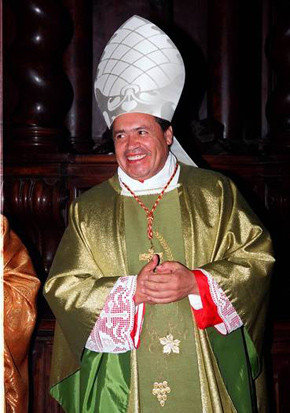
In a sermon Sunday, Cardinal Norberto Rivera Carrera announced that a vice rector at the Conciliar Seminary of Mexico received a number of threatening phone calls Nov. 20-21. The callers, the cardinal said, demanded 60,000 pesos — about $4,500 — “in exchange for respecting the lives of the superiors of that institution,” according to a statement issued Sunday evening by the Archdiocese of Mexico.

la-ms-rivera-carrera-jpg-20131202

“Last week we were meeting in the seminary; they called numerous times, and identified themselves as La Familia Michoacana,” Rivera said, according to the news service Milenio, referring to a drug cartel based in Michoacan state. “But who knows?”

The allegation will register as less than shocking to many here, and not only because extortion calls are so common. Mexicans are also inured to the fact that the Catholic Church generally receives little immunity from the depredations of Mexico’s wave of organized crime.

That reality was driven home in May 1993 when Cardinal Juan Jesus Posadas Ocampo was shot to death in the parking lot of the Guadalajara airport. Federal investigators concluded that hit men for the Tijuana cartel mistook the cardinal’s car for that of one owned by Sinaloa cartel leader Joaquin “El Chapo” Guzman, although many Mexicans never bought the explanation.

More recently, a number of priests and church officials have been subject to violence and threats. Last month, two priests were gunned down in an apparent robbery attempt at a parish residence in Veracruz state. In October, Miguel Patiño, the bishop of Apatzingan, a city in troubled Michoacan, released an open letter denouncing the power of drug gangs there and reportedly received death threats after speaking out.

In July, the bishop of Cuernavaca state said a priest in the area had been a victim of extortion, and had also received threats of violence.

Though top Catholic leaders have denounced the culture of violence here, some parishes have benefited from drug world largesse, accepting donations from capos to finance church renovations and community projects.

Cardinal Rivera, according to the archdiocese, instructed the rector of the Mexico City seminary to report the threatening phone calls to officials. In his sermon, according to the statement, he “lamented the spiral of violence that has been growing in the country.”

Photo: Cardinal Norberto Rivera Carrera, above in October 1998, announced Sunday that a vice rector at the Conciliar Seminary of Mexico received threatening phone calls. Rivera has instructed the seminary to report the calls to authorities. (Corrado Giambalvo / Associated Press, via LA Times)


THE MEXICAN PRESIDENCY @ YEAR ONE

600px-Fd
Originally posted at www.latimes.com:

After president’s first year, Mexico still a mess by many measures

President Enrique Peña Nieto is having a tough time delivering on his bold promises, analysts say. The economy is stagnant and crime numbers are mixed

By Richard Fausset
December 1, 2013, 7:49 p.m.

MEXICO CITY — To President Enrique Peña Nieto’s supporters, his first year in office has been a time of bold promises kept as he pursues an ambitious agenda of reforms designed, in the long term, to bring peace and economic growth to Mexico.

But in the short term, by many measures, his country remains a mess.

Though he promised to focus on Mexico’s economic potential, Peña Nieto has presided over an economy that has hardly grown at all. Though he vowed to reduce the kind of violence that affects innocent citizens, his record has been mixed, with kidnappings and extortion rising nationwide even as the number of homicides drops.

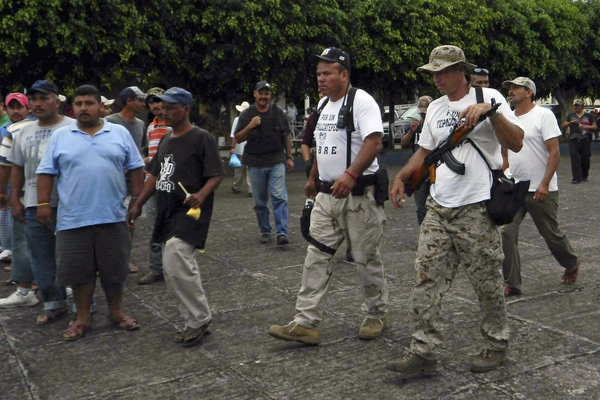
And the drug war rages on. In recent months, the key agricultural state of Michoacan has devolved into something close to a failed state, as armed peasants have formed ad hoc militias to protect themselves from the surging cartel menace. On Wednesday, the president’s finance minister, Luis Videgaray, declared that the ongoing chaos there was a threat to Mexico.

As Peña Nieto marks his first year in office, he has successfully pushed major banking, education, tax and telecommunication reform bills through Congress, and is pursuing changes in the crucial oil industry. Yet the young, confident and telegenic president, who as a candidate promised a “government that delivers,” is facing doubts about his ability to do just that.

A poll from El Universal newspaper last month put Peña Nieto’s approval at 50% and his disapproval at 37% — his worst numbers so far as president. In the newspaper Excelsior, columnist Leo Zuckermann last week noted that the president had failed to transform the positive story he tells about Mexico into actual good news.

“It was one thing to ‘sell’ great expectations, which the Peña government did very well,” Zuckermann wrote, “and another very different thing to deliver good results.”

On Sunday, thousands of the president’s critics marched in the historic center of Mexico City to protest his first year in office, and the idea of opening the state oil monopoly to foreign investment.

Some protesters threw rocks at a storefront and at the headquarters of Televisa, the giant TV network that many consider to be biased in Peña Nieto’s favor. Seven protesters were reportedly arrested.

The government expects the Mexican economy to grow by an anemic 1.3% this year, which many analysts blame largely on a troubled world economy.

The president, meanwhile, is asking his fellow Mexicans to give his big-picture agenda time to generate results.

“I am sure that the foundations that we are achieving will be very firm and solid, and will allow Mexico to have more economic growth and more social development,” Peña Nieto said at an October business summit in Guadalajara. “I’m convinced of it.”

While the president’s initiatives have included some ideas that could be considered liberal, including tax hikes and an anti-hunger program, others have sought to address the market distortions that linger from the last century, when his Institutional Revolutionary Party, or PRI, ruled Mexico with a dollop of socialism and a heap of corruption.

It may be a challenge, however, to convince Mexicans that a radical transformation is truly underway. This is a country with a history of passing beautifully constructed laws that often end up doing little to change the real-life status quo. Some critics argue that Peña Nieto and his allies have allowed key elements of their reform package to be watered down and made less effective as they compromised, trying to mollify often raucous special interest groups and opposition political parties who had agreed to a general reform framework in a so-called Pact for Mexico, signed just after Peña Nieto’s inauguration.

The education law, for example, has been criticized for not being tough enough on chronically underperforming educators: Teachers can be reassigned, but not fired, for repeatedly failing new evaluation tests. The law was passed over the fierce objections of a radical union whose protests choked Mexico City for weeks.

The tax proposal, meanwhile, sought to boost revenue in a country that has the lowest tax collection rates in the developed world. Though the law that eventually passed included some tax increases, a proposed sales tax on food and medicine was left out in an effort to placate the left.

Peña Nieto has yet to push through the most controversial change of all: a plan to open the bloated and inefficient state oil monopoly, Pemex, to foreign investment. The company supplies a third of the federal government’s income, but production is dwindling precipitously, and analysts say Pemex requires injections of foreign expertise and technology to turn itself around. But the constitution mandates that oil is the property of the Mexican people, and the issue touches deep chords of national pride.

Peña Nieto’s team has backed a proposal to share profits with foreign oil concerns, but not the cut of the petroleum itself that those companies would prefer.

The legislature could vote on the proposal by year’s end. Jorge Castañeda, a well-known intellectual, is among those who believe that the president and his team should get behind a production-sharing plan, or something like it, in hopes of delivering Mexico a dramatic economic boost.

“They know they have to do something more, that just profit-sharing is not going to do the job,” Castañeda said. “But they may or may not have the political capital left at this stage to do more. If they had done energy reform at the beginning, maybe it would have been easier.”

Meanwhile the left-wing Democratic Revolution Party, which opposes such measures, pulled out of the much-ballyhooed Pact for Mexico in protest.

On the crime front, federal figures show that homicides for the first 10 months of 2013 were down 16% compared with the same period in 2012, but extortion was up 10% and kidnappings up 33%. Such numbers come with multiple caveats: Prominent critics have charged that the government is manipulating the homicide statistics, while the extortion and kidnapping figures could reflect an increase in the reporting of crimes to authorities.

Peña Nieto has struggled in his efforts to resolve the conflict with the drug cartels that has left thousands of people dead and come to define the country in the eyes of the world. The president had hoped to lower his reliance on the military, which was sent into the streets by his predecessor to push back against the cartels. Yet when trouble escalated in Michoacan, Peña Nieto appeared to have little choice but to send in the troops.

As a candidate, Peña Nieto promised to create a paramilitary police force known as the “gendarmerie” to do some of the work the military is doing now. But its rollout has been delayed, and officials have changed their statements about its mission and makeup. “The gendarmerie,” says Mexican security expert Alejandro Hope, “is a joke.”

Last week, the international group Human Rights Watch sent an open letter to Peña Nieto accusing him of having a human rights strategy that was “largely confined to rhetoric” while lacking “a concrete plan” for combating violence.

In an interview, Sen. Ana Lilia Herrera of the PRI repeated the administration’s contention that there had been a fundamental change in security strategy, one that stressed better “coordination” among government officials.

Such is the rhetoric. Mexicans are waiting to see if it produces results.

richard.fausset@latimes.com
Copyright © 2013, Los Angeles Times

Illustration: Not Necessarily The Mexican President (Nickelodeon)

IN THE STREET

Xiomara Castro

Originally posted at www.latimes.com:

Thousands march in Honduras to protest election result

Second-place finisher Xiomara Castro leads marchers in Tegucigalpa to protest what they say was electoral fraud.

By Richard Fausset
December 1, 2013, 7:56 p.m.

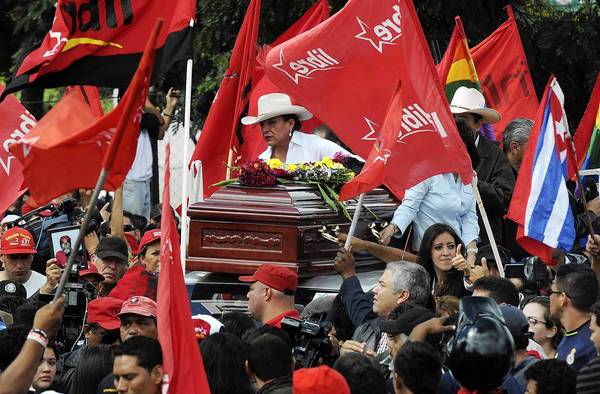
MEXICO CITY — Thousands of leftists marched in the Honduran capital of Tegucigalpa on Sunday to protest — peacefully but vehemently — the Nov. 24 election of a conservative presidential candidate that they say was marked by fraud.

The protesters, many sporting red baseball caps or waving red banners, were led by Xiomara Castro, the candidate of the left-wing Free Party, and her husband, Manuel Zelaya, who was ousted from the presidency in a 2009 coup.

They appeared beside a casket containing the body of Jose Antonio Ardon, a Free Party activist who was gunned down Saturday, the Telesur TV channel reported. Although officials have not said who was behind the shooting, people in the crowd were already directing their ire at the conservative National Party and its winning candidate, Juan Orlando Hernandez.

“Assassins,” the protesters chanted, according to Agence France-Presse. “Blood of martyrs, seed of liberty!” they continued. “Fraud!”

Hernandez’s victory was confirmed Saturday night by Honduras’ electoral institute, which said that he took 37% of the vote compared with Castro’s 29%. (The rest of the votes were split among candidates from smaller parties.) On Sunday afternoon, the Free Party took to Twitter to reiterate its pledge to formally challenge the results on Monday.

Castro and her husband have demanded a recount, alleging, among other things, that 20% of the pro-Castro ballots were hidden by election officials. International election monitors said that the vote tally was probably accurate. But in Honduras, conservative forces largely control the machinery of government, which gives them the ability to dole out jobs and other perks before election day in exchange for support.

Honduras has been reeling from violence and rising poverty since the ouster of Zelaya, who boosted social spending but raised concerns among some that he was seeking to retain power indefinitely. A report issued last  month by the Washington, D.C.-based Center for Economic and Policy Research found that the gap between rich and poor has soared since the coup, making Honduras the country with the worst economic equality in Latin America.

Observers fear that political violence could erupt with a disputed election. But on Sunday, at least, the protests, which were policed by heavily armed security forces, concluded peacefully, according to reports.

Copyright © 2013, Los Angeles Times

Photo: In Tegucigalpa, Honduras, presidential runner-up Xiomara Castro rides on the roof of a car carrying the coffin of a supporter killed a day earlier during a protest. (Fernando Antonio / Associated Press / December 1, 2013, via LA Times)


ON NPR

I was on NPR’s “All Things Considered” Friday, discussing the case of the teenage killer for the Mexican drug cartels who has served his time in the Mexican penal system, and is now free in the US. Click here to listen.


TITHES

Mexico protest over government corruptionPlaying catch-up today. Here’s a story from Nov. 22. Originally published www.latimes.com:

Mexico lawmakers accused of demanding kickbacks from municipalities

Some allegedly demand a 10% cut of federal projects money from local leaders already beset by drug cartels.

By Richard Fausset
November 22, 2013, 7:05 a.m.

MEXICO CITY — No one ever said it was easy being a mayor in Mexico, where corruption is as common as cacti, politics is a Machiavellian game of three-dimensional chess and drug cartels are often more powerful than local governments.

But in recent days, Mexicans have seen the depth of the challenge facing the men and women charged with running the 2,438 municipios, roughly the equivalent of U.S. counties, that are supposed to be a building block of governance here.

The mayor of Santa Ana Maya, a rural municipality in Michoacan state, was killed this month after complaining that cartel members were regularly demanding a chunk of the federal money meant for public works projects in his area, a practice he said was widespread.

Now it seems the drug lords may not be the only ones demanding their cut.

Several lawmakers and heads of local governance associations recently have begun accusing legislators in the Mexican Congress of also regularly shaking down municipal governments, demanding that they kick back “tithes” of at least 10% if they want infrastructure projects included in federal budget plans. Sometimes the lawmakers allegedly demand that projects be built by specific companies that are run by their cronies.

Though no proof of the practice has emerged, the allegations have plunged Mexico City, the capital, into full scandal mode, with investigations demanded and lawsuits threatened. Former allies have turned on one another.

An anonymous legislator last week singled out the conservative party’s leader in the lower chamber, Luis Alberto Villarreal, accusing him of taking a 10% cut of projects last year worth about $45 million.

Villarreal has denied the charge and has made threats of legal action, presumably against his accuser if he or she is ever identified.

Some powerful members of Villarreal’s National Action Party, meanwhile, are among those clamoring for an investigation, and have asked Villarreal to step down in the meantime. Others are hoping the matter will be discussed by a proposed new anti-corruption commission, an idea introduced by President Enrique Peña Nieto that has yet to be approved by Congress.

Corruption in Mexican government is a well-known fact of life, and many mayors are presumed to be crooked as well. But some observers are incensed by the notion that federal officials may have been sapping the strength of local governments at a time when they needed to be stronger than ever to face the threats posed by drug gangs.

Eduardo R. Huchim, a columnist for the newspaper Reforma, wrote this week that the federal government had forgotten that municipalities, “being the authority closest to society” needed strengthening.

“It hasn’t been that way,” he wrote, “and they’ve practically been left to their own devices.”

The heightened drug violence in recent years has made it risky business to be a mayor, with 44 killed during the last seven years, according to Ricardo Baptista, director of the Assn. of Local Authorities of Mexico.

Many mayors have been too afraid to speak out about the alleged extortion from legislators and have turned instead to local governance associations like Baptista’s to make the issues public.

“Some are at risk of losing their lives, and others are at risk of going to jail for entering into these [corrupt] practices,” Baptista said Wednesday after a tribute to the slain mayor, Ygnacio Lopez Mendoza, outside the Mexican Senate.

Just as bad, Baptista said, is that residents lose faith in the government.

Federico Estevez, a political scientist at the Autonomous Technological Institute of Mexico, said the long-term solution may be to lift the prohibition on mayors and legislators running for second terms. That, he said, would force them to make their case to voters that they had managed public funds responsibly.

Estevez was unusual in seeing a positive side to the scandal. In the less democratic Mexico of the recent past, he said, the alleged illicit payments sought by officials might never have come to light.

Cecilia Sanchez of The Times’ Mexico City bureau contributed to this report.

Copyright © 2013, Los Angeles Times

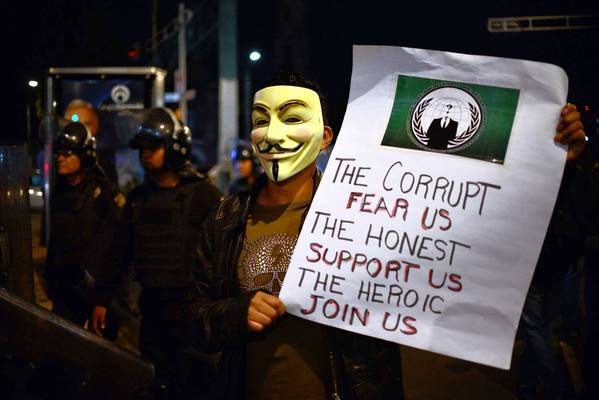
Photo: A protester in a Guy Fawkes mask takes part in a Mexico City demonstration against government corruption. (Yuri Cortez, AFP/Getty Images / November 5, 2013, via LA Times)

http://www.latimes.com/world/la-fg-mexico-mayors-20131121,0,7050172.story#ixzz2mFHCm1Vt

http://www.latimes.com/world/la-fg-mexico-mayors-20131121,0,7050172.story#ixzz2mFH4pZPs

http://www.latimes.com/world/la-fg-mexico-mayors-20131121,0,7050172.story#ixzz2mFGzuMLf


KID

Edgar Jimenez Lugo, known as "El Ponchis, in 2010

Originally posted at www.latimes.com:

Mexican teenage assassin to soon live freely in Texas

Now 17, Edgar Jimenez Lugo, a drug cartel killer known as ‘El Ponchis,’ is released from Mexican detention after serving three years. A U.S. citizen, he will soon be living in San Antonio.

By Richard Fausset and Cecilia Sanchez
November 26, 2013, 7:52 p.m.

MEXICO CITY — He admitted being a salaried killer for a drug cartel, the kind of assassin who preferred slashing his victims’ throats.

On Tuesday, after serving three years behind bars, he was released from a Mexican detention center and was on his way to the United States — where he would soon live as a free man.

Or, rather, a free boy.

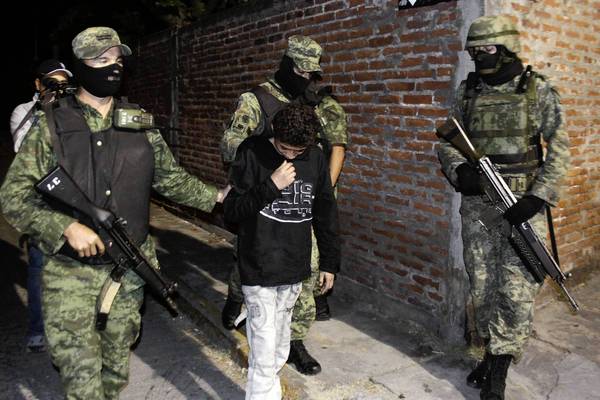
The killer, Edgar Jimenez Lugo, known to Mexican crime reporters as “El Ponchis,” is 17 years old. He was 11 when he killed his first victim, and he was 14 when he was arrested, in December 2010, at the Cuernavaca airport, along with luggage containing two handguns and packets of cocaine.

Back then, Jimenez’s tender age transformed him into a media phenomenon, one that shocked Mexico, and the world, into recognizing the extent to which the country’s brutal drug war was consuming its young. And now it is one of the reasons why Jimenez — who claims to have killed four people at an age before most kids get their learner’s permit to drive — will soon be mingling with the residents of San Antonio.

Under the laws at the time in the Mexican state of Morelos, where he was prosecuted, Jimenez could be sentenced to a maximum of only three years of incarceration because he was a minor. A judge ordered him released Tuesday, a few days before his three years were up.

And because he is a U.S. citizen, born in San Diego, he has every right to return to his home country.

“Apparently he’s paid his debt for whatever crimes he was convicted of [in Mexico], and I’m not aware of any charges the U.S., federal or state, has against him,” Michelle Lee, an FBI special agent based in San Antonio, said Tuesday. “The situation with him is really no different than any other U.S. national who commits a crime, completes their sentence and is released.”

Jimenez, who had lived, and killed, in Jiutepec, a town near the popular resort city of Cuernavaca, was on a plane headed to San Antonio, where he has family, Jorge Vicente Messeguer Guillen, the Morelos government secretary, said in a TV interview.

Once in San Antonio, Messeguer said, Jimenez would be sent to what he referred to as a “support center” but would not be locked up.

Graco Ramirez, the Morelos governor, said in a separate TV interview that Jimenez’s rehabilitation in the Mexican penal system had been “notable.” He also said that Jimenez had to leave Mexico because his life might be in danger.

U.S. State Department officials would not elaborate on what Jimenez’s living arrangements would be when he arrived in Texas. Nor did they clarify what Messeguer meant by a “support center.”

“We are aware of Edgar Lugo’s upcoming release by the Mexican authorities following completion of his sentence,” a spokesman for the U.S. Embassy in Mexico City said in a statement Tuesday. “We are closely coordinating with our Mexican counterparts and appropriate authorities in the United States regarding Edgar Lugo’s release.

“Due to privacy considerations, we do not publicly discuss details of matters involving U.S. citizens,” he said.

Jimenez’s case is far from unique. In February, a 13-year-old boy was arrested in the state of Zacatecas along with a group of gunmen. The boy, identified as Armando, confessed to participating in at least 10 slayings. He was freed because the state criminal code does not prosecute minors younger than 14. A month later, the boy and his mother were found slain along with four other people.

In 2011, a 15-year-old who went by the name Erick was arrested and said he worked for the same group that Jimenez did, participating with other teenagers in kidnappings and drug dealing. He was sentenced to two years and eight months in prison.

Similar cases have come to light in the states of Jalisco, Tabasco and Veracruz, but probably represent only a small fraction of the total: Studies by the National Autonomous University of Mexico have estimated that a million youths are at risk of being recruited by the cartels.

Jimenez’s release is likely to rekindle the debate about the justice system’s treatment of minors who commit serious crimes. In 2005, the Mexican Constitution mandated the creation of separate justice systems at the state and federal levels for offenders younger than 18.

More recently, there has been a push to take a harsher stance, exacerbated in part by the drug cartels’ habit of drawing from the country’s vast pool of poverty-stricken, poorly educated children to form their ranks.

In March, Morelos lawmakers increased the maximum sanction for children who commit serious crimes so that a suspect like Jimenez would serve five years, not three, behind bars, a change that came about as a result of his case. In July, the state of Veracruz went further, raising the maximum penalty for 14- to 16-year-olds from four years to 10 years of incarceration, with 16- to 18-year-olds now facing the possibility of 15 years.

Such changes have concerned some children’s rights groups, but the clamor is not likely to die down. Javier Lozano, a senator with the conservative National Action Party, or PAN, sent a series of Twitter messages on Tuesday asking Mexicans to consider lowering the minimum age for trying children as adults.

“The liberation of ‘Ponchis’ speaks of a perverse system in which under the pretext of being a minor, one can be an assassin, but not a criminal,” he wrote.

After his arrest, Jimenez claimed that he had killed at the behest of a man who was a suspected cartel enforcer who threatened to kill the boy if he did not follow orders. He said that his employer, the Beltran Leyva cartel, paid him $200 a week, and that he was stoned on marijuana when he committed the crimes.

He was, in many ways, a perfect drug-war recruit: destitute and from a broken family. In the 1990s, child welfare officials removed Jimenez and five siblings from their parents’ custody in San Diego. In a 2010 interview with The Times, Edgar’s father, David Jimenez, said that he and his wife had been known to fight violently.

Edgar’s grandmother was appointed legal guardian and brought the children to Mexico. But she died in 2004, and Edgar dropped out of school in the third grade.

“I’m not defending him,” Messeguer said. “But … his circumstances caused him to be a victim as well.”

richard.fausset@latimes.com

Fausset is a Times staff writer. Sanchez is a news assistant in The Times’ Mexico City bureau. Times staff writer Molly Hennessy-Fiske in Houston contributed to this report.

Copyright © 2013, Los Angeles Times

Photo: Mexican soldiers escort Edgar Jimenez Lugo, known as “El Ponchis,” in Cuernavaca, Mexico, at the time of his arrest in December 2010, when he was 14. Having served three years behind bars — then the maximum for a minor in Morelos state — Jimenez was released Tuesday and will soon be settling in the United States, where he was born. (Antonio Sierra / Associated Press /December 3, 2010, via LA Times)

http://www.latimes.com/world/la-fg-mexico-killer-kid-20131127,0,1846457.story#ixzz2mFFLOKkO

http://www.latimes.com/world/la-fg-mexico-killer-kid-20131127,0,1846457.story#ixzz2mFFDewVz

http://www.latimes.com/world/la-fg-mexico-killer-kid-20131127,0,1846457.story#ixzz2mFF1Hfdr

MAD FLOW

APphoto_Mexico Vigilantes

Originally posted at www.latimes.com:

Mexican cartels abet heroin and meth surge in U.S., DEA study says

By Richard Fausset
November 19, 2013, 6:39 p.m.

MEXICO CITY — The availability of heroin and methamphetamine in the U.S. is on the rise, due in part to the ever-evolving entrepreneurial spirit of the Mexican drug cartels, according to a new study released by the Drug Enforcement Administration.

The report, which analyzes illicit drug trends through 2012, also notes that cocaine availability was down across the United States. It offered various possible reasons for the decline, including cartel versus cartel fights over drug routes in Mexico, declining production in Colombia and various anti-narcotics strategies that have put more heat on the groups that control production and shipment of the product.

The yearly report, released Monday and known as the National Drug Threat Assessment Summary, is an effort to describe “the threat posed to the United States by the trafficking and abuse of illicit drugs.”

The report is a synthesis of quantitative data and survey feedback from more than 1,300 state and local law enforcement agencies. Among other things, it provides an updated profile of the seemingly intractable user-pusher relationship that has developed between the United States  and its southern neighbor.

According to the report, the amount of heroin seized at the southern U.S. border increased 232% between 2008 and 2012 — apparently the result of greater Mexican heroin production and a growing incursion by  Mexican traffickers into U.S. markets. It notes that the U.S. is experiencing a “sizable increase” in the number of new heroin users.

Methamphetamine seizures at the Mexican border, meanwhile, increased fivefold in the same time period, although the report notes that U.S. demand and abuse data for meth appeared to remain stable.

The trouble with meth is most acutely felt in the West: The report notes  that 2011 arrest data showed that large percentages of arrestees in Western states tested positive for meth, with rates much lower in the East. For example, 42.9% of men arrested in Sacramento tested positive for methamphetamine; in Washington, DC, that number was 0.4%.

Marijuana continues to be Americans’ illicit drug of choice. Smuggling from Mexico has remained “consistently high” for 10 years, the report says, while U.S. domestic production is on the rise — in part due to large-scale U.S. growing operations controlled by Mexican traffickers.

The U.S. government appears to be tolerating recent decisions by voters in Washington and Colorado to legalize marijuana for recreational use in those states. But the plant remains classified as a dangerous and illegal controlled substance under federal law, and the report warns, darkly, that drug cartels will “increasingly exploit the opportunities for marijuana cultivation and trafficking created in states that allow ‘medical marijuana’ grows and have legalized marijuana sales and possession.”

The report notes the continued decline of availability of cocaine in the U.S., a trend that began in 2007. The majority of cocaine that ends up in the U.S. is of Colombian provenance, and much of it must first travel through Mexico. The United Nations has noted a decline in Colombian coca production, and U.S. officials have credited the success of Plan Colombia, the United States’  multibillion-dollar drug-fighting effort in Colombia, which includes, among other things, military aid, crop eradication programs and social spending.

Critics of U.S. drug policy fear that the pressure on Colombia is only pushing production to other countries, like Peru, a phenomenon commonly known as the “balloon effect.”

The title of “fastest growing drug problem” in the U.S., according to the report, goes to prescription drugs, including painkillers, which are often obtained domestically at unscrupulous “pill mills,” or from online sellers.

The report says that recent state laws to crack down on pill mills could create another kind of balloon effect, forcing “abusers and distributors to obtain [prescription drugs] in other areas of the country where little or no legislation currently exists … or in other countries such as Canada and Mexico.”

Photo: Vigilantes arrive in the town of Pareo, in Mexico’s Michoacan state. The Knights Templar drug cartel controls parts of the state, and a “self-defense” movement has arisen to fight it. (Agencia Esquema /November 16, 2013, via LA Times)

HORRORSHOW

FAMILY STABBED TO DEATH

Originally posted at www.latimes.com:

Mexico: Family of eight stabbed to death in Juarez

By Richard Fausset
November 18, 2013, 9:47 a.m.

MEXICO CITY — For the second time in two months, the Mexican border city of Juarez is reeling from a harrowing massacre, the victims this time a religious family of eight, including three children, whose bound, lifeless bodies were found with multiple stab wounds, according to state officials and local media reports.

The victims, discovered Sunday, include two girls, ages 4 and 6; a 7-year-old boy; three women, ages 25, 30 and 60; and two men, ages 30 and 40, according to the Chihuahua prosecutor’s office. As of Monday, no suspects had been detained.

The newspaper El Diario reported that the dead, who had been bound and gagged with packing tape, were members of a Jehovah’s Witness group. Fellow congregation members stumbled onto the crime scene when they stopped by the family’s house to check on them after they had failed to show up for Sunday religious services, the paper reported.

Friends of the family also found a 3-month-old baby girl in the house who had been spared in the assault, according to media reports.

The gruesome discovery, combined with a Sept. 22 shooting that left 10 dead at a suburban house party, is likely to amplify the debate about the tenuous security gains Juarez has enjoyed in recent months.

Four years ago, the city was ranked, by some measures, as the most violent in the world, due in large part to a running turf war between the Sinaloa and Juarez drug cartels. In 2009, a homicide occurred on average about every three hours, and a quarter of the population fled the city.

The Mexican federal government, led by then-PresidentFelipe Calderon, sent in thousands of troops, and intensified a massive security and social-programs push after another massacre on Jan. 31, 2010, in which 15 celebrants at a house party were slain by gunmen, sparking a national outrage.

Last year saw a significant decline in slayings. Officials have been touting the influence of new classrooms, programs for troubled youth, and upgraded tools and training for police — some of which was funded by the U.S. government.

But many suspect that the decline is due largely to the Sinaloa cartel’s victory over its rivals.

It was unclear if the latest massacre was connected to drug cartel activity. But for many residents, the immediate focus was not on the motives, but on the human toll.

“Who in the hell … would assassinate three kids?” wrote one commenter on the El Diario website. “Not even irrational beasts would do such a thing.”

Photo: Forensic experts investigate at a house in which eight people were stabbed to death in the Mexican city of Juarez. (EPA, via LA Times)

EL CHOQUE DE LO NUEVO

Museo Jumex

Originally posted at www.latimes.com:

Mexico City’s Museo Jumex explores art’s modern edge

The new museum embarks on a modern art mission that stands apart from much of the Mexican capital’s steeped-in-history collections.

By Richard Fausset
November 19, 2013, 6:00 a.m.

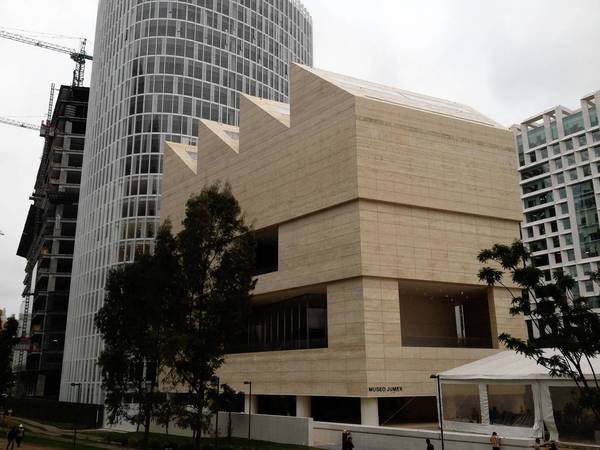
MEXICO CITY — The Museo Jumex, the latest museum to go up in this deliriously art-rich city, is a stout limestone box of a building, with a signature roof made up of four right triangles lined up in a jagged row. They are, almost literally, new waves.

Don’t say you haven’t been warned.

The museum, fueled by the riches of Grupo Jumex, the massive Mexican fruit juice company, opens Tuesday in a bustling, ultramodern neighborhood of glass-and-steel high rises just north of the ritzy Polanco district. It will be dedicated almost entirely to art that came after the peak of classic Modernism.

Though there are other venues for contemporary art in the Mexican capital, the Jumex, with its high-profile location and deep-pocketed patron, is likely to do more than any other to bring a shock of the new to a city largely defined by its vast troves of pre-Columbian, colonial and 20th century masterworks.

“We’re looking ahead,” Jumex collection coordinator Humberto Moro said last week as he gave a sneak peek of an inaugural exhibition dedicated to the work of the late American conceptual artist James Lee Byars. “Otherwise, we’d be building another Diego Rivera museum. Which would be great, but…”

Moro’s half-finished thought speaks volumes about the mission of the Jumex. In quintessential Mexican style, the museum takes pains to honor the past: As part of it opening activities it is releasing a book exploring the work of Fernando Gamboa, 20th century Mexico’s most important art curator and museum director. The pointy roof, meanwhile, appears to be architect David Chipperfield’s sly reference to a similar design found atop the former studio of Diego Rivera and Frida Kahlo, in the city’s San Angel district.

But the real focus of the Jumex will be on what happened long after such art giants roamed the land. Central to the museum’s mission is the display of works from the 2,600-piece Coleccion Jumex, consisting largely of art created after 1990. Assembled by Eugenio Lopez Alonso, the heir to the Grupo Jumex fortune, it is widely considered to be one of the most important collections of its kind in Latin America.

Many of the artists in the collection are Mexicans who have made a splash on the international art circuit. The new building will allow them to take center stage back home, while exhibitions by important non-Mexicans — the museum is also featuring seven Minimalist sculptures by the late American artist Fred Sandback — will give local audiences an idea of the broader world in which they operate.

“For the last 10 years, Mexico has completely inserted itself in the global contemporary art circuit,” said David Garza-Usabiaga, curator of the Museo Universitario Del Chopo, another contemporary art venue here. “I think that the Museo Jumex will reaffirm that much more.”

The museum plans to regularly rotate works from its permanent collection. The first wave of 57 pieces on display gives a good sense of what’s in store: a bull’s head rotting in a transparent box, courtesy of Damien Hirst, the 48-year-old British art star; a stack of mirrored, peach-tinted boxes, at once austere and playful, from the late American artist Donald Judd.

Nearby, along a long stretch of wall, is a 2009 installation, “The Count of the Days,” by Mexican artist Daniel Guzman, consisting of everyday household items, a few pre-Columbian designs, and a series of images that one might find in any contemporary newspaper here: mutilated bodies, beauty queens, a soccer star.

The museum’s location is its own kind of statement, set among the offices of multinational companies like General Motors and Colgate Palmolive (the United States embassy is also set to move here from the more central Paseo de la Reforma eventually). The new building is also a few steps away from the Museo Soumaya, opened in 2011 to house the art collection of Mexican tycoon Carlos Slim, one of the world’s richest men. The Soumaya is the more daring building, a swooping, aluminum covered form reminiscent of an hourglass — or the base of a toilet. But the Soumaya’s collection is a hodgepodge, including both Rodin sculptures and Slim’s coin collection. It is the Jumex that has the more focused, and daring, mission.

The staff is aware that it may be tricky to sell the masses on art’s bleeding edge. While Mexican art stars of the previous century, like Rivera, famously strove to be at once avant-garde and populist, many later strains of art have tended to be more difficult and abstruse.

Spokeswoman Mariana Huerta said that the staff has had plenty of practice fielding skepticism. For the last dozen years the collection has been showcased in a museum on the outskirts of Mexico City, in the working-class municipality of Ecatepec on the grounds of a Jumex juice plant (the original building will remain open).

The trick, she said, is not to lecture but to seek dialogue, even among doubters. “If they say, ‘I don’t like it,’ we say, ‘That’s fine. Tell me why you don’t like it,'” she said.

richard.fausset@latimes.com

Photo: Mexico City’s new Museo Jumex, which opens Tuesday, will focus on Mexican and international contemporary art. (Richard Fausset / Los Angeles Times / November 18, 2013)

BOSS

Joaquin Hernandez Galicia


Originally posted at www.latimes.com:

By Richard Fausset
November 11, 2013, 8:38 p.m.

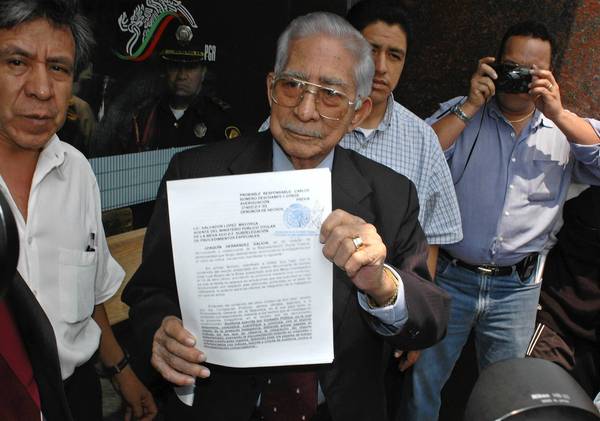
MEXICO CITY — Joaquin Hernandez Galicia, the former Mexican oil union boss who rose to control a political empire built on patronage and intimidation but was eventually dethroned by a Mexican president wary of his vast power, died Monday. He was 91.

Hernandez, who went by the nickname “La Quina,” a play on his first name, died in the port city of Tampico, where he had been hospitalized with an abdominal ailment, according to the news agency Notimex.

Both the rise of Hernandez, starting in the 1950s, and his subsequent arrest by former President Carlos Salinas de Gortari in 1989, demonstrated the legacy of the old feudal system that infected Mexican public life long after the country’s independence from Spain. His heyday was also emblematic of the unique 20th century labor system in Mexico, in which unions, instead of challenging government, were deeply integrated into a one-party political structure within which all disputes and power struggles were meant to be resolved.

Mexico has become a more democratic country in the 21st century. Even so, many of the old-school unions remain intact, including Hernandez’s union, which represents workers in the crucial, but troubled, state-run oil company, Petroleos Mexicanos, or Pemex. These vestiges of an older, less-transparent time present an ongoing challenge to those who purport to represent the forces of modernization and reform.

“Pemex was a latrine of corruption before La Quina came in, but he turned it into a sewer of corruption,” George W. Grayson, a Mexico expert at the College of William and Mary, said Monday. “And it still is.”

Hernandez was a man of slight build, the son of an oil worker who eschewed flash and who, though trained as a welder, possessed uncanny political skill. After rising to the top of the union in 1958, he maintained control by doling out favors to local politicians and everyday workers, personally receiving underlings who would ask for loans or help with marital problems.

He also had a reputation for violence. He was publicly accused of the 1977 slaying of a rival, Heriberto Kehoe Vincent, although the accusation was never proven. Two of his bodyguards also allegedly admitted to killing another rival in the 1980s.

But Hernandez’s gravest sin, at least in the eyes of the Institutional Revolutionary Party, or PRI, was to grant his nearly 200,000 members free rein to vote for the presidential candidate of their choice in the 1988 elections. The PRI, which had dominated Mexican politics for decades, nearly lost that election, with Salinas, its candidate, receiving 50.7% of the vote in a count that was suspected to be fraudulent.

In previous elections, the PRI could have counted on the union’s support, but Hernandez was concerned about Salinas’ plans to bring more efficiency to Pemex — which could have meant weakening the union.

On Jan. 10, 1989, the Salinas government, facing the threat of further intransigence from the union leader, had him arrested on weapons charges. Hernandez was also charged in the slaying of a federal agent who died in a shootout that ensued with Hernandez’s bodyguards when government officials tried to make the arrest.

Hernandez was sentenced to more than 30 years in prison, but was released under an amnesty in 1997. He had long maintained that the charges were bogus.

After his arrest, Hernandez ceased to be a player on the national stage. But his legacy lived on. Soon after the current president of Mexico, Enrique Peña Nieto, took office last December, his government arrested the old-school political boss of the teachers’ union, Elba Esther Gordillo, who potentially stood in the way of a promised educational reform.

Many observers assumed that Peña Nieto was following Salinas’ playbook in the Hernandez affair.

Peña Nieto has also proposed reforming Pemex, where Hernandez’s union continues to hold sway. Its workers enjoy some of the best perks in Mexico, including rent and gas subsidies, scholarships for their children, access to a health system of 15 clinics and 22 hospitals.

But a 2011 study by the Texas-based Baker Institute found that the workers were 25% as efficient as the workers at British oil giant BP, and about half as efficient as the workers at Petrobras, the partially state-owned oil company in Brazil.

richard.fausset@latimes.com

Cecilia Sanchez of The Times’ Mexico City Bureau contributed to this report.

Copyright © 2013, Los Angeles Times

Photo: Joaquin Hernandez Galicia in 2005. Hernandez rose to the top of the oil workers union in 1958. In the 1988 elections, he granted his workers free rein to vote for the candidates of their choice, raising the ire of the ruling party. (Roberto Velazquez, Associated Press / May 27, 2005, via LA Times)